
Lunar eclipse, ascent of Venus highlight month of March
A calendar of the best and brightest night-sky sights as we transition from winter to spring.
By Bob King

On Feb. 27, Venus was very low in the western sky about 45 minutes after sunset but bright enough that it was obvious. The planet moves up and away from the sun this month and gets a little easier to see each night. Contributed / Bob King
Spring is coming, and new constellations are afoot. While the winter groups still dominate, we see signs of spring with the appearance of Leo in the eastern sky, the Big Dipper rising ever higher, and the flashing light of the orange-red star Arcturus low in the northeastern sky. To find Arcturus, follow the arc of the Dipper’s handle down toward the horizon and it will take you right to it. If you’re up after midnight look in the same direction for brilliant Vega, the first star of the Summer Triangle to make its appearance.
The number of visible planets dwindles this month. Mars is still lost in the glare of morning twilight, while Mercury and Saturn depart into the solar glow at sunset. This leaves two bright, naked-eye evening planets, Jupiter and Venus. Jupiter shines high in the southern sky and bright enough to see in the still-blue sky as soon as 20-30 minutes after sundown. Venus starts the month very low in the west, yet high enough to see with ease around 45 minutes after sunset. Throughout the month it climbs higher and gets even easier to see.
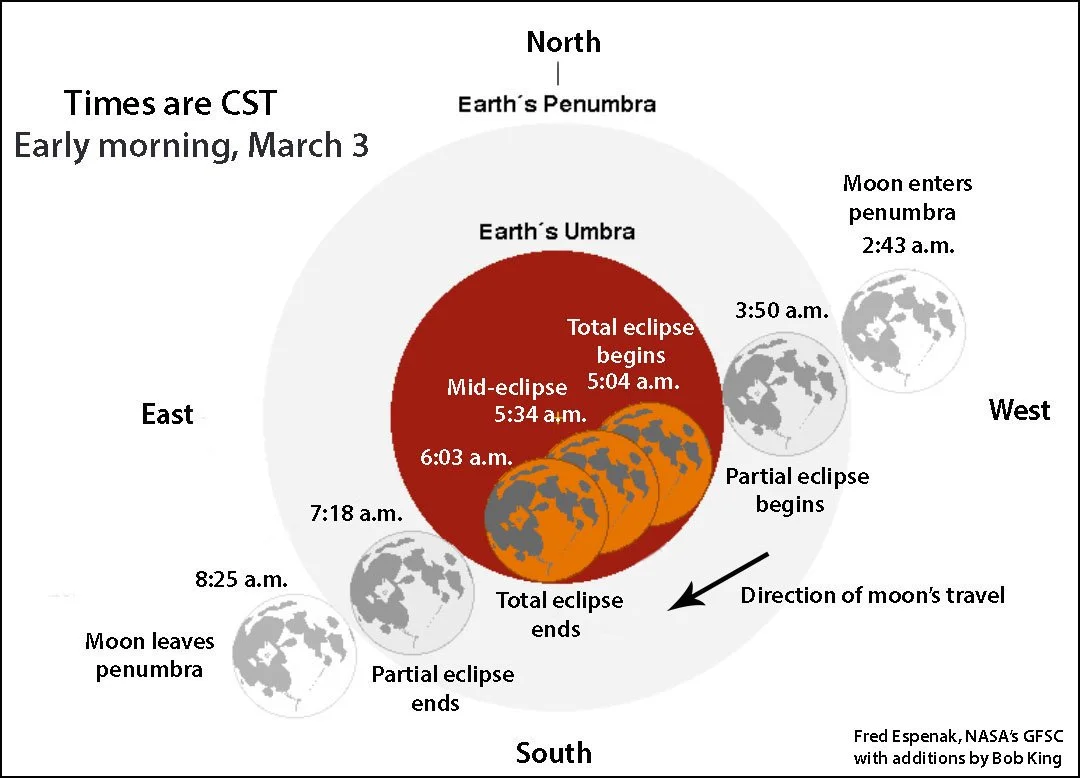
The diagram shows the moon's progress across Earth's outer and inner shadows — penumbra and umbra — during the March 3 total lunar eclipse. Times are Central Standard. Contributed / Fred Espenak, NASA's GFSC with additions by Bob King
The biggest happening will be the total lunar eclipse on Tuesday morning, March 3. It’s visible across the entire U.S., but the western half of the country is favored because folks there will see the full eclipse from partial through total and back to partial. If you live in the eastern time zone, the moon sets while still in total eclipse. In the Midwest, we’ll see all of totality, but the moon will set while still partially eclipsed.
For the Central Time Zone, the partial eclipse starts at 3:50 a.m., when the moon begins its passage through Earth’s dark, inner shadow called the umbra. Look for a dark “nibble” along the moon’s eastern (left) side. The total eclipse begins at 5:04 a.m. and lasts 59 minutes. For nearly an hour, the moon lies fully within Earth’s shadow and glows a striking orange or rusty-red color. At 6:03 a.m. the moon begins to exit the umbra and partial eclipse resumes. Morning twilight will already be underway at this time.
If you live in the Midwest (or East), the moon will be low in the western sky during totality, so be sure you find a spot in advance that has a good view of the western horizon otherwise trees or buildings may cover up the eclipse. The upside of the moon being low during morning twilight is that you’ll have enough light to photograph the orange moon in a deep blue sky and include something pretty in the foreground. The next total lunar eclipse won’t be until June 2029.
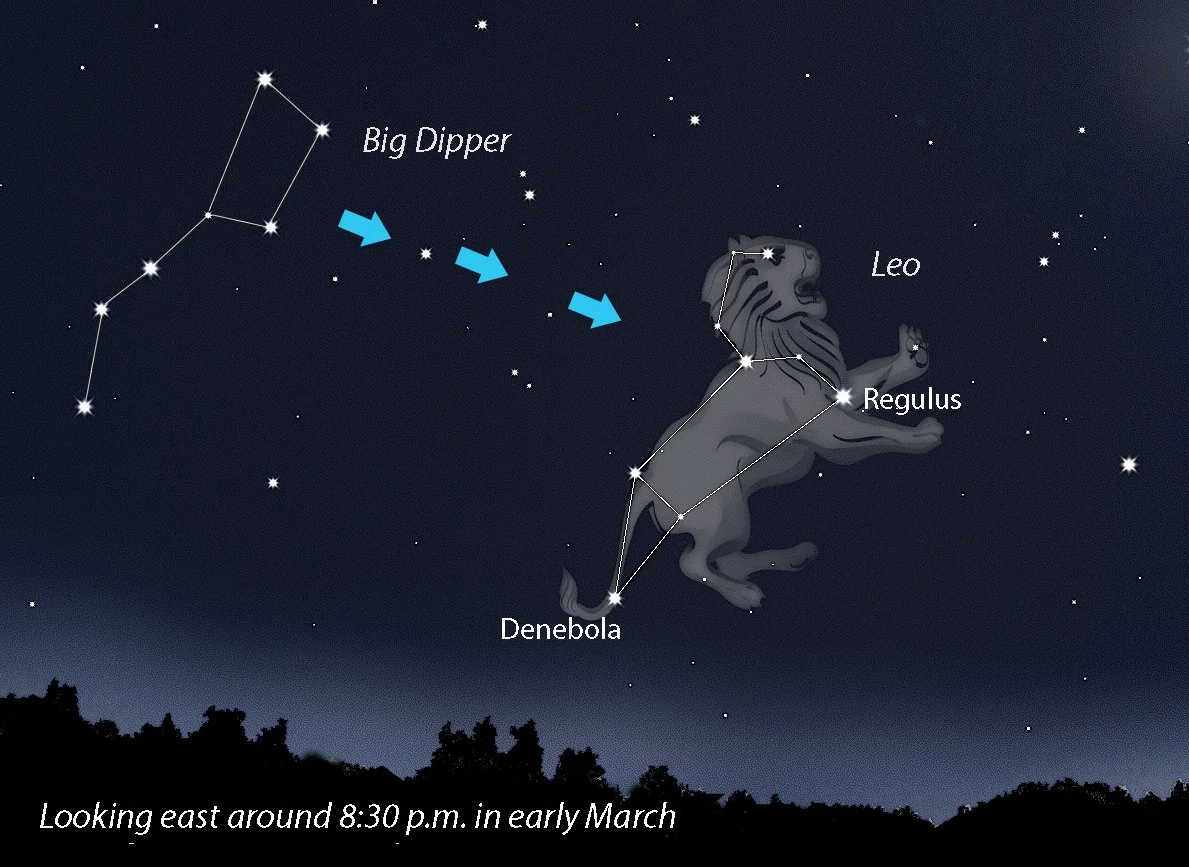
Look east around 8:30-9 p.m. CST (9:30-10 p.m. CDT starting March 8) to find Leo the Lion. You can start at Regulus, the constellation's brightest star, or use the Big Dipper, located off to the left in the northeastern sky. The lion is about four "fists" to the right and slightly below the Dipper. Contributed / Stellarium with additions by Bob King
Our featured constellation is Leo the Lion, which gets high enough in the eastern sky for a good look around 8-9 p.m. local standard time (9-10 p.m. Daylight Time starting March 8). Leo’s stick-figure looks a little like a real lion. It has two parts – a head shaped like a backwards question mark, and a triangle-shaped tail. There’s a gap between the two, but when you connect them, it’s not too difficult to imagine a crouching animal. The lion earned its spot in the sky as the king of the beasts.
Download the free Stellarium Mobile app for Android and iPhone to help you find and identify the current planets and constellations. It will also display Jupiter’s moons, which can help you track them down with binoculars or a telescope. Do a Google search, then install the app, set it in night mode (red screen) and point your phone skyward. For a free March 2026 sky map and calendar go to skymaps.com/downloads.html. For updates, aurora alerts and news, check out my Facebook at facebook.com/astrobobking.
Events (a.m. indicates the event happens in the morning sky):
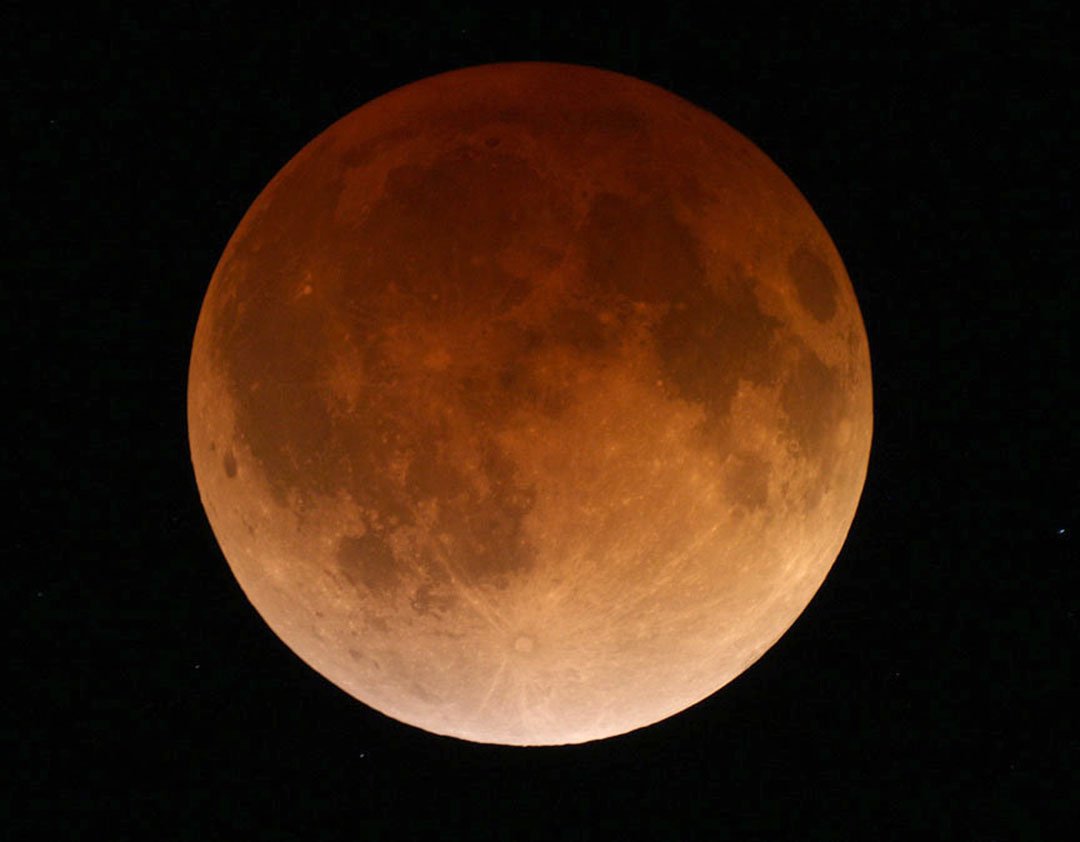
During totality, when the moon is fully engulfed in Earth's shadow, the atmosphere refracts (bends) reddened sunlight around the planet's circumference into the shadow and colors the moon in shades of orange and red. Contributed / Bob King
March 3 – Full Worm Moon. If the weather’s good, don’t miss the total lunar eclipse happening in the early morning hours of Tuesday, March 3.
March 5 – Waning gibbous moon shines to the right of Spica, Virgo’s brightest star.
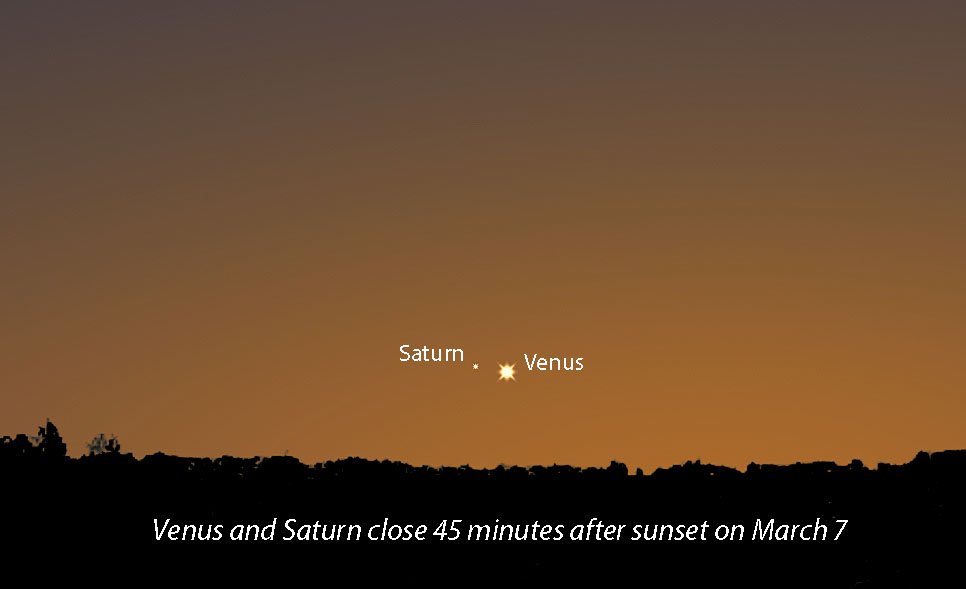
Point your binoculars at Venus on the evenings of March 7 and 8, and you'll see it has a fainter partner, the planet Saturn. Contributed / Stellarium
March 7 and 8 – Venus and Saturn are in close conjunction just 1 degree apart on both nights. Venus is easily visible about 45 minutes after sunset very low in the western sky. Saturn will be swamped in the twilight glow, so you’ll need binoculars to spot fainter Saturn. On the 7th, Saturn will be to the left and a little above Venus. On the 8th, it will to the left and below Venus.
March 8 – Daylight Saving Time begins at 2 a.m. this morning
March 10 – Half-moon in conjunction with orange-red Antares, the brightest star in Scorpius the Scorpion. The moon will shine only about 1 degree below the star.
March 10-29 – The International Space Station will make one to two passes each evening. For a complete list of flyovers for your city, log in to Heavens-Above.com, select your location and then click the blue ISS link. Or download and install NASA’s Spot the Station app at the app store or Google Play.
March 11 – Last quarter moon. Rises around midnight and stands due south around sunrise.
March 18 – New Moon. The moon is near the sun in the daytime sky and not visible.
March 20 – Spring begins at 9:46 a.m. Central Daylight Time. Day and night are equal at 12 hours apiece. The sun rises due east and sets due west.
March 20 – Thin crescent moon shines about a fist above Venus at dusk.
March 24 – Half-moon only about 1 degree to the left of the bright-ish star Elnath, which marks one of the horns of Taurus the Bull.
March 25 – First quarter moon shines to the upper left of brilliant Jupiter tonight.

Bob King is an amateur astronomer, author, and passionate educator. He served as a photographer and photo editor at the Duluth News Tribune for 39 years and taught at the UMD planetarium. Bob’s work had a great impact on Voyageurs National Park. To achieve International Dark Sky Park certification, the park was required to host dark sky education events. Through the Night Sky Explorer webinars, the Conservancy was able to fulfill this component and help secure the certification for Voyageurs National Park. We can’t thank Bob King enough for sharing his talents and knowledge with the Conservancy community to support dark sky preservation.
