
Most of the action this month will be at dusk in the western sky. That’s where Venus and Jupiter will meet in a close conjunction on June 9, with the planet Mercury’s a stone’s throw away. About a week later, a delicate lunar crescent joins the scene in a wonderful, zigzag planet-moon alignment.
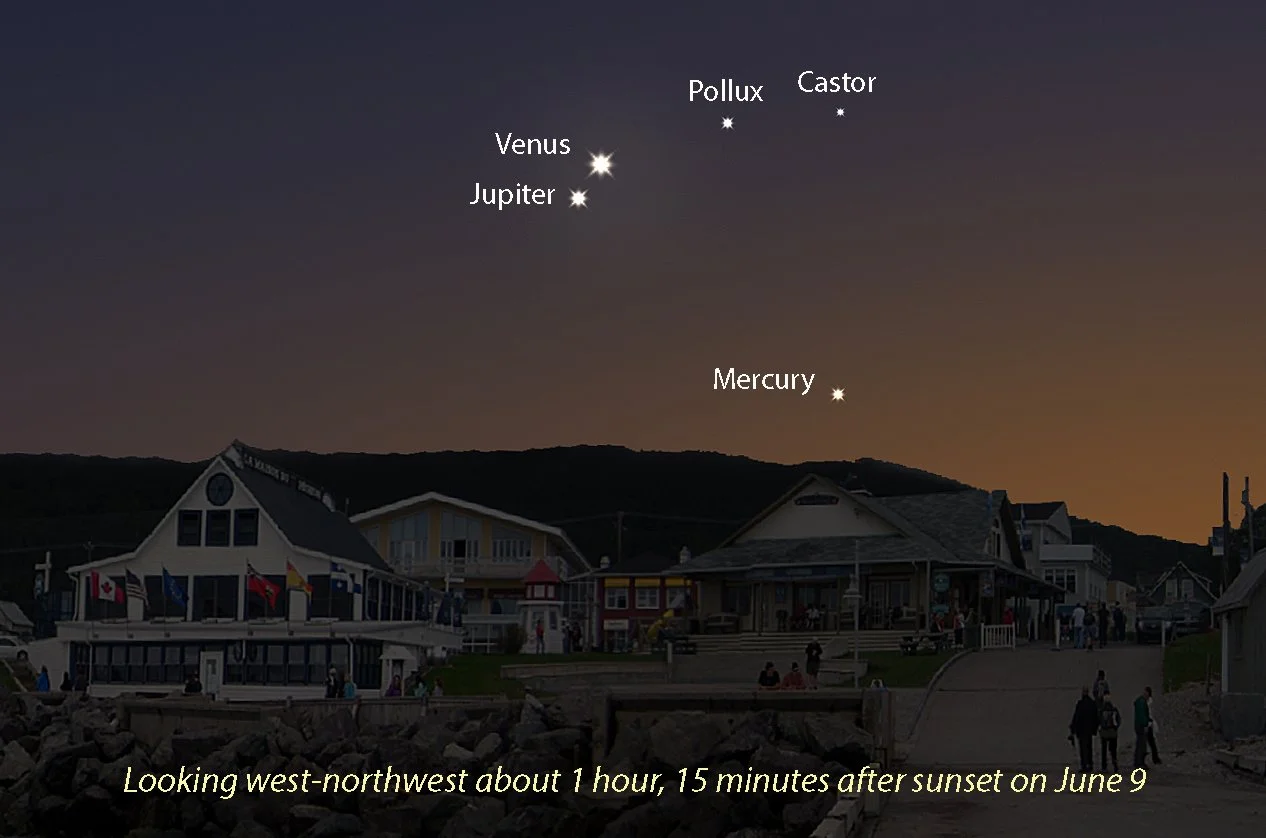
To prepare for this multi-act show, find a location with a wide-open view to the west- northwest. Bring bug spray, since the mosquitos will likely be biting by then, and arrive about 45 minutes to an hour after sunset. Although Mercury will be fairly bright, it will be lower than Venus and Jupiter and may require binoculars. It’s closer to the horizon than the other two so it will set first.
In the dawn sky, Saturn is getting higher and easier to see. Also, for the first time this year, Mars returns to view low in the northeastern sky at dawn. That means you could potentially see all five bright, classical planets this month.
Our featured constellation is Scorpius the Scorpion. Some people call it “Scorpio”, which is the name for the related astrological sign of the zodiac. In Greek mythology, the Scorpion was sent by the Earth goddess Gaia to fatally sting Orion the Hunter after he boasted he could kill any creature on Earth.
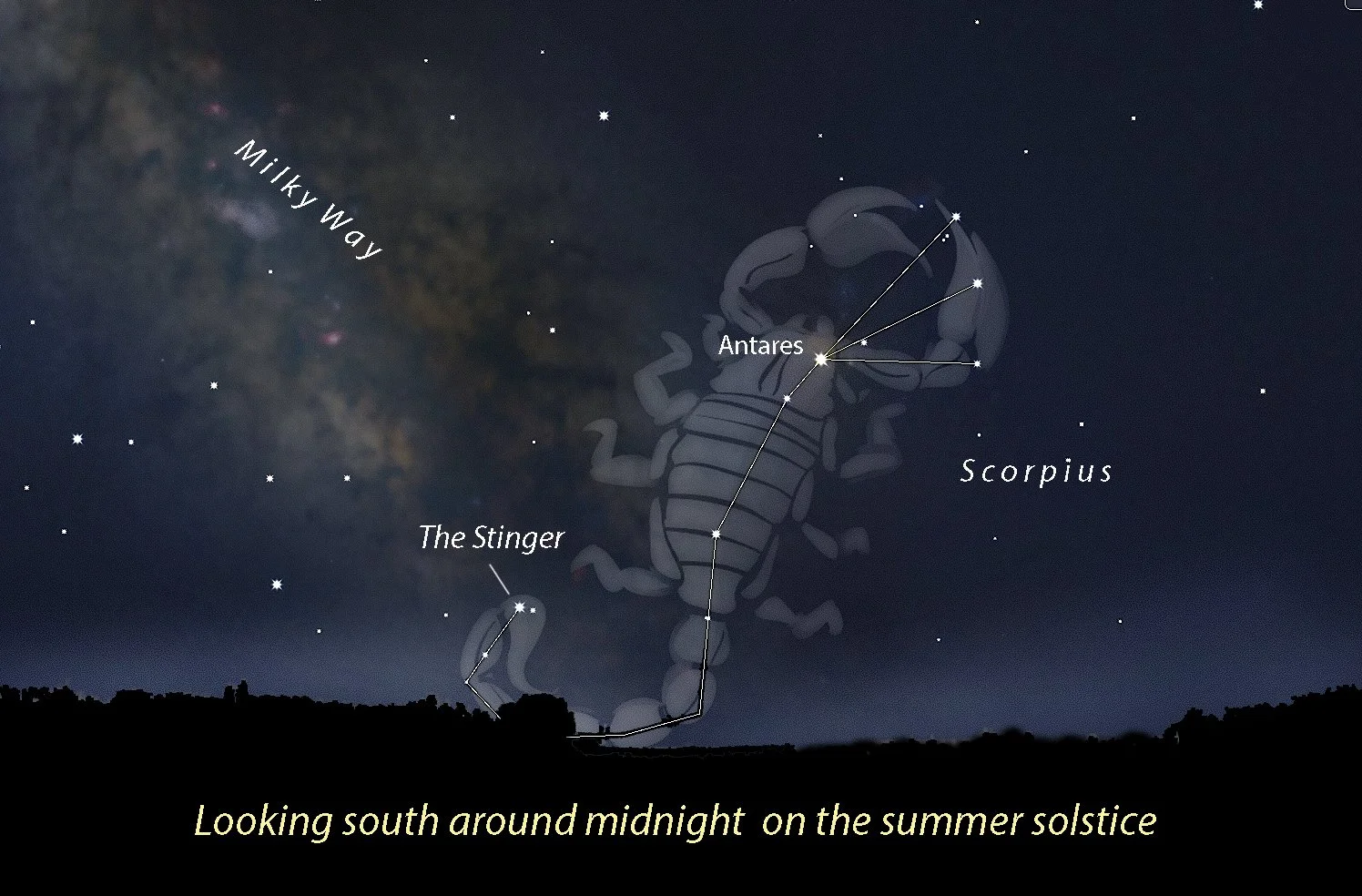
The placement of the two constellations aptly illustrates the story. Orion flees the scene, setting in the west, at the same time his nemesis, the Scorpion, crawls up the eastern sky. You’ll see the scorpion’s head low in the southeast as soon as it gets dark. But you’ll have to wait until midnight to see the constellation’s full outline. As we move into summer it rises earlier.
Scorpius’s roots go back deep in time. The Sumerians, who occupied southern Mesopotamia around 3000 B.C., called it Gir-Tab, their word for scorpion. Even today, many stargazers would agree that this curlicue of stars bears a good resemblance to the feared arachnid. It features the prominent, bright star Antares, the scorpion’s heart, and Shaula the Stinger Star at the tip of its tail.
Download the free Stellarium Mobile app for Android and iPhone to help you find and identify the current planets and constellations. It will also display Jupiter’s moons, which can help you track them down with binoculars or a telescope. Do a Google search, then install the app, set it in night mode (red screen) and point your phone skyward.
For a free June 2026 sky map and calendar go to www.skymaps.com/downloads.html. For updates, aurora alerts and news, check out my Facebook at https://www.facebook.com/astrobobking.
Events (a.m. indicates the event happens in the morning sky)
June 1 – Venus and Jupiter start the month about 7.5 degrees (less than a fist) apart. Catch them in the northwestern sky 45 minutes to 2 hours after sunset.
June 1-14 – Mercury makes a brief appearance at dusk starting about 45 minutes after sunset. Look for the innermost planet with binoculars about a fist and a half to the lower right of the Venus-Jupiter combo.
June 7-10 – Venus, the brighter planet, passes Jupiter at dusk. They’ll be closest on June 8 and 9 at 1.6 degrees (three full-moon diameters) apart.
June 8 (a.m.) – Last quarter moon. Rises around midnight and stands in the south at sunrise.
June 10 (a.m.) – Waning crescent moon shines above and left of Saturn low in the southeastern sky in early dawn.
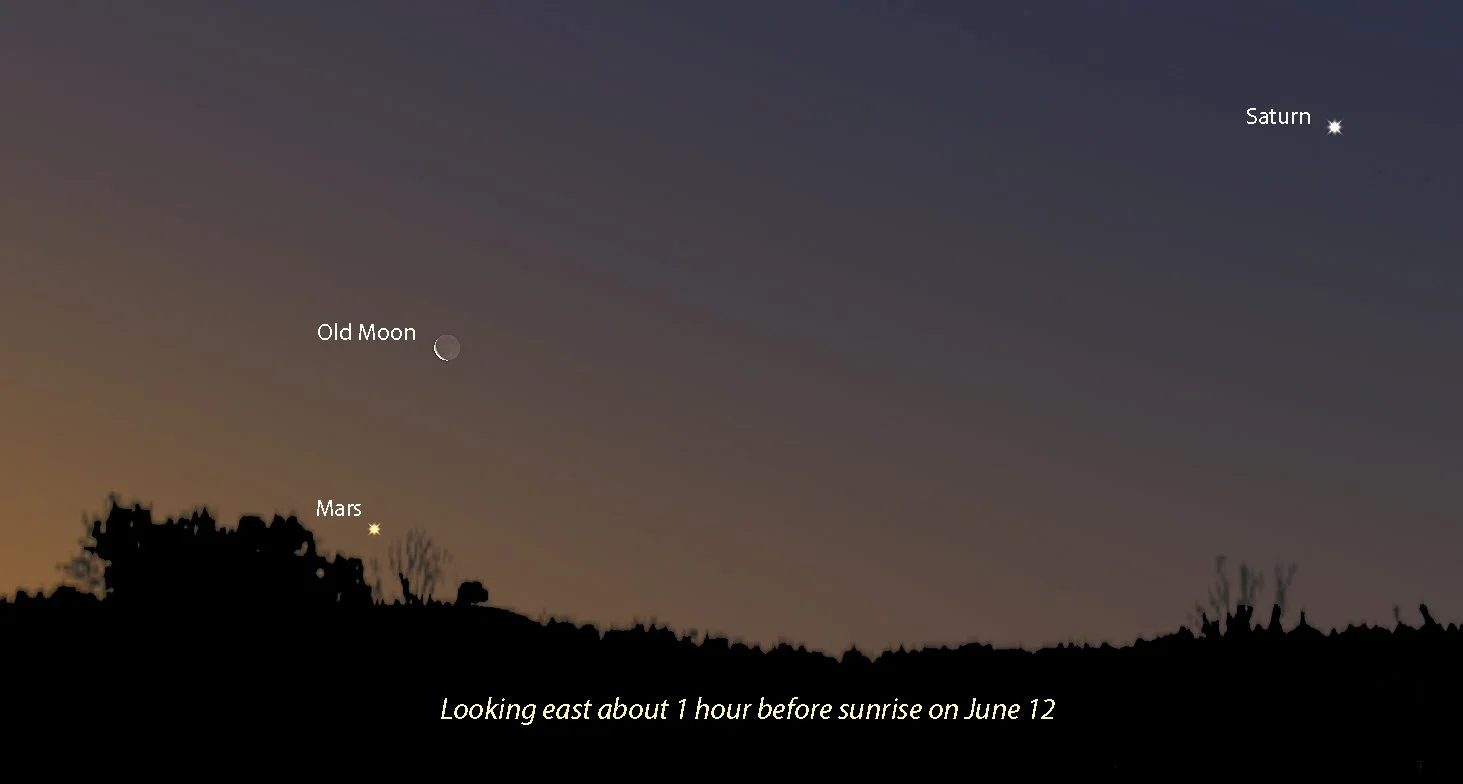
June 12 (a.m.) – Mars peeks into view low in the northeastern sky during early- to mid-dawn. Use this morning’s waning crescent to help you find it. The Red Planet shines a short distance below and left of the moon.
June 13 (a.m.) – Find the paper-thin crescent an hour before sunrise low in the northeastern sky. In binoculars you’ll see the Pleiades star cluster to its left in the same field of view.
June 14 – New moon. The side of the moon facing Earth will be in darkness and also in the same line of sight as the sun, so we can’t see it.
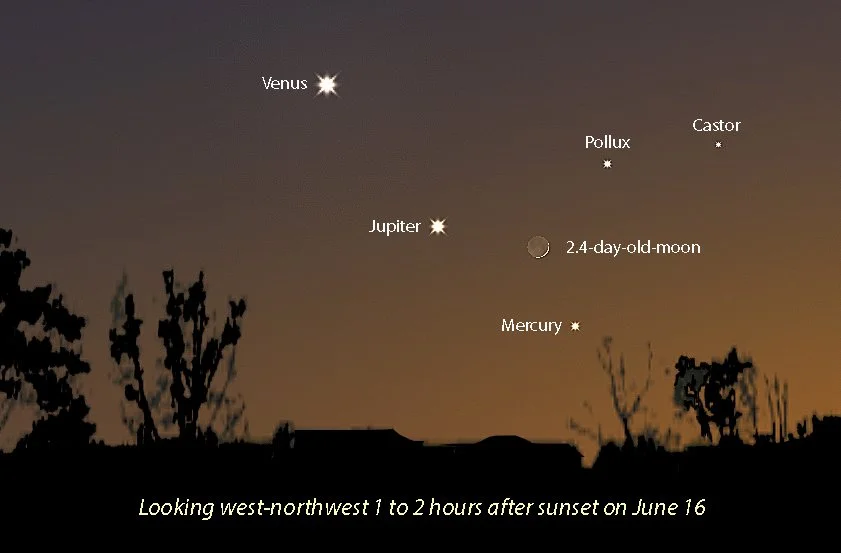
June 16 – A thin lunar crescent joins the planet lineup at dusk low in the northwestern sky. Mercury shines to the moon’s lower right, with Jupiter and Venus above and left of the crescent. Together they form a delightful zigzag arrangement.
June 17 – A slightly thicker crescent moon now leads the planetary parade with Venus, Jupiter and Mercury trailing behind to the west.
June 19 – Venus shines within the northern outskirts of the Beehive Cluster in Cancer. Look 1-2 hours after sunset and use binoculars.
June 19-30 – The International Space Station will make one to two passes at dawn. For a complete list of flyovers for your city, log in to Heavens-Above.com, select your location and then click the blue ISS link. Or download and install NASA’s Spot the Station app at the app store or Google Play.
June 21 – Summer solstice at 3:25 a.m. CDT. Today’s date marks the first day of summer and the longest day – and shortest night − of the year.
June 21 – First quarter moon stands in the south at sunset.
June 23 – Waxing gibbous moon shines to the lower left of Spica, Virgo the Virgin’s brightest star.
June 29 – Full Strawberry Moon rises around sunset in Sagittarius, the “Teapot” constellation, and shines all night. Go to https://www.timeanddate.com/moon/ to find your local moonrise time.