
#11 Ernest Oberholtzer
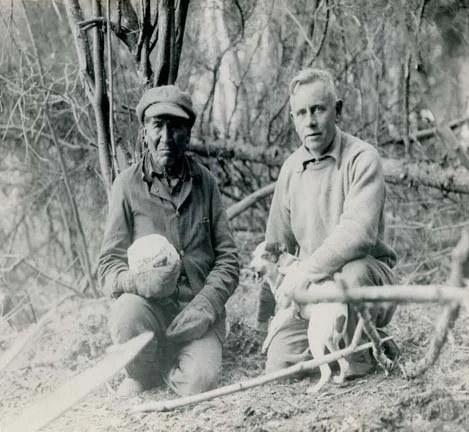
Oberholtzer (right) & Magee (left) with dog Skippy. Credit: Minnesota Historical Society
Ernest Oberholtzer (1884- 1977) was born and grew up in Davenport, Iowa. After earning a bachelor’s degree from Harvard University in 1907, he was drawn to the Northwoods. Among many challenges in his life, he had experienced heart damage caused by rheumatic fever and had been told he could die within a year. So, he headed for Minnesota and took up canoeing.
“Ober” as he was called in the canoe country and beyond, first paddled the lakes of the Rainy Lake watershed in 1909. At the age of 25, he discovered a great love for the wilderness and said that his health “improved with every stroke of the paddle.” He met an Ojibwe man named Dedaabaswewidang (He Who Echoes Far Off, also known as Billy Magee). They became friends and together shared a “3,000-mile summer,” paddling through the woods and waters of the historic Voyageurs fur trade, all the way to Hudson’s Bay that first summer together, and would do it again in 1912 (when Magee was a seasoned 51 year old). The Rainy Lake Anishinaabe People would eventually give Ober the name of Atisokan, meaning legend or teller of legends. By the end of Ober’s life, his story would grow to fulfill the implications of this name.
Starting in the 1920s, Oberholtzer lived on Rainy Lake’s Mallard Island, one of five islands that make up the archipelago known as the Review Islands. These early experiences proved critical in shaping Ober’s future preservation efforts. He became a prominent conservationist and led the campaign for legislation to protect the watershed, including parts of what would become Voyageurs National Park, the Boundary Waters Canoe Are Wilderness, and the greater Quetico-Superior Area.
In 1925, Ober’s love for exploring the wilderness evolved into a passion to save it. Edward Backus, a paper and lumber baron, proposed a series of dams in the Rainy Lake watershed to create water storage areas and a more efficient controlled power source. Backus asked the U.S. and Canadian governments to pay for the dams and to compensate landowners for the inevitable flooding that would occur. Both countries declined. If Backus’ plan were to succeed, water would have backed up across an area of nearly 15,000 square miles, significantly raising some lake levels as much as 80 feet, flooding Mallard Island and much of the watershed’s shoreline.
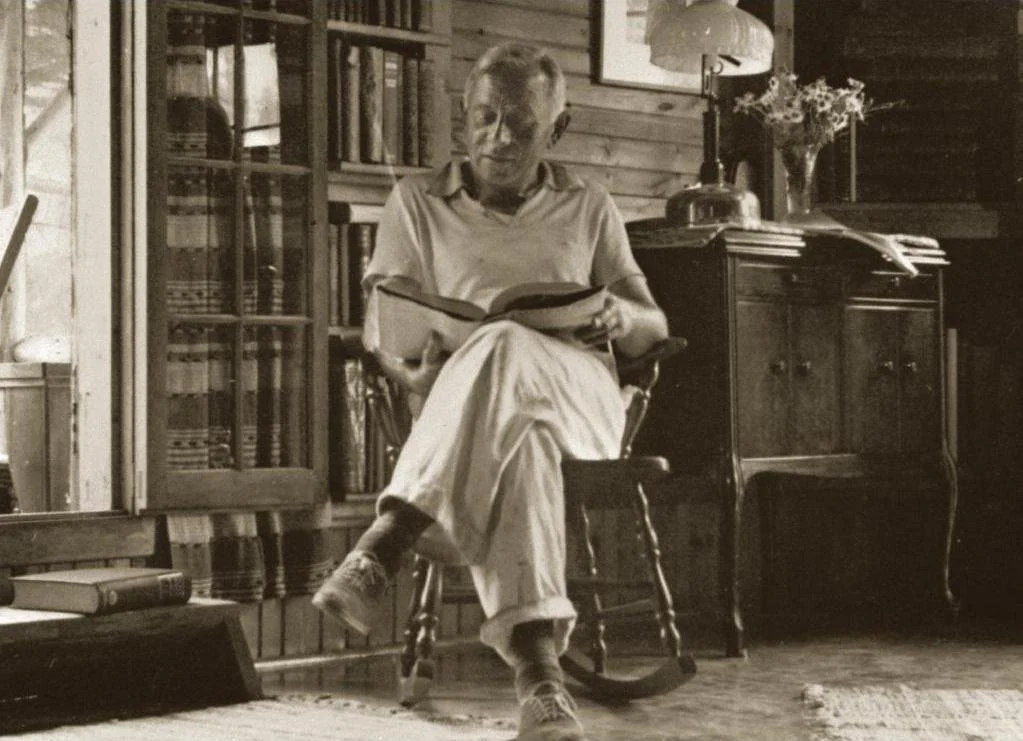
Oberholtzer circa 1940’s. Credit: Conservation Minnesota
Oberholtzer had quickly become Backus’ nemesis by creating his own plan to have the Rainy Lake watershed region be controlled as its own bioregion. Ironically, the two men were neighbors on Rainy Lake. Close friends said they did not feel anger towards one another but disagreed with what each stood for.
Oberholtzer initially hatched the idea of having both the U.S. and Canada sign a treaty marking the Quetico-Superior region an International Peace Memorial Forest in honor of all those who fought in WWI. These efforts led to the birth of the Quetico-Superior Council, who hired Ober to lobby and direct their operations at a salary of $5,000 a year. He was known as such an eloquent speaker that a Backus supporter attending a Kettle Falls meeting once said, “Don’t let him talk or he’ll have everybody on his side.”
Oberholtzer’s persistence eventually led to the passage of the Shipstead-Newton-Nolan Act in 1930, signed into law by President Herbert Hoover. Backus’ dream of unlimited industrialization collapsed. It was a historic moment in that it was the first legislation ever passed by the U.S. Congress to mandate wilderness values on federal lands, preventing dams from changing natural water levels and logging from being allowed closer than 400 feet from shore. “Destroy the beauty of the visible shores and islands of these lakes and rivers and you destroy the whole charm and pleasurable utility of the region for the public,” Ober wrote.
Ober’s ongoing fight for the conservation of this region did not go unnoticed by President Franklin Delano Roosevelt who, in 1934, appointed Ober as first chair of the newly formed Quetico-Superior Committee, which served the same purpose as the Quetico-Superior Council but on a federal level. Ober’s service didn’t end there as he continued to fight for wilderness preservation as a part of the Wilderness Society, which he helped found to help future generations experience the outdoors as he had. In 1967, Ober received the recognition he deserved from the Department of the Interior as he was awarded the Distinguished Service Award for his preservation efforts.
Over time, Oberholtzer and the many other conservationists with whom he worked were successful in setting aside millions of acres of the “canoe country,” the woods and waters of voyageurs and the Ojibwe, and those that still call this place home. He continued to live on or near Mallard Island until 1973. In the latter years of his life, parts of the watershed became well-known Minnesota wilderness areas. The Boundary Waters Canoe Area Wilderness was created in 1964, and Voyageurs National Park was established in 1975. In 1977, the man known as “Ober” and “Atisokan,” the teller of legends, died at the age of 93.
Today, Mallard Island and many of Oberholtzer’s possessions are preserved by the Oberholtzer Foundation. His home was added to the National Register of Historic Places in 2000 (Rainy Lake Islands Historic District). To learn more about his home and foundation on Mallard Island, visit: www.EOber.org
Check out the full list of our 50 legacies!
This year, we’re celebrating 50 years of Voyageurs National Park by sharing 50 inspiring stories of the people who shaped its legacy. Years, 50 Legacies is a yearlong storytelling series highlighting individuals whose lives are woven into the fabric of the park – whether through conservation work, cultural traditions, recreation, research, or personal connection.
Raise a canteen and celebrate this historic milestone with us at our 50th anniversary website. Don't forget to subscribe to our newsletter for more inspiring stories and updates!
