
May 2025 Night Sky Explorer by Bob King
With pleasant temperatures and mosquitos still waiting in the wings, May is wonderful month to be outside at night. Two bright planets are visible at dusk, but one of them is slipping away.
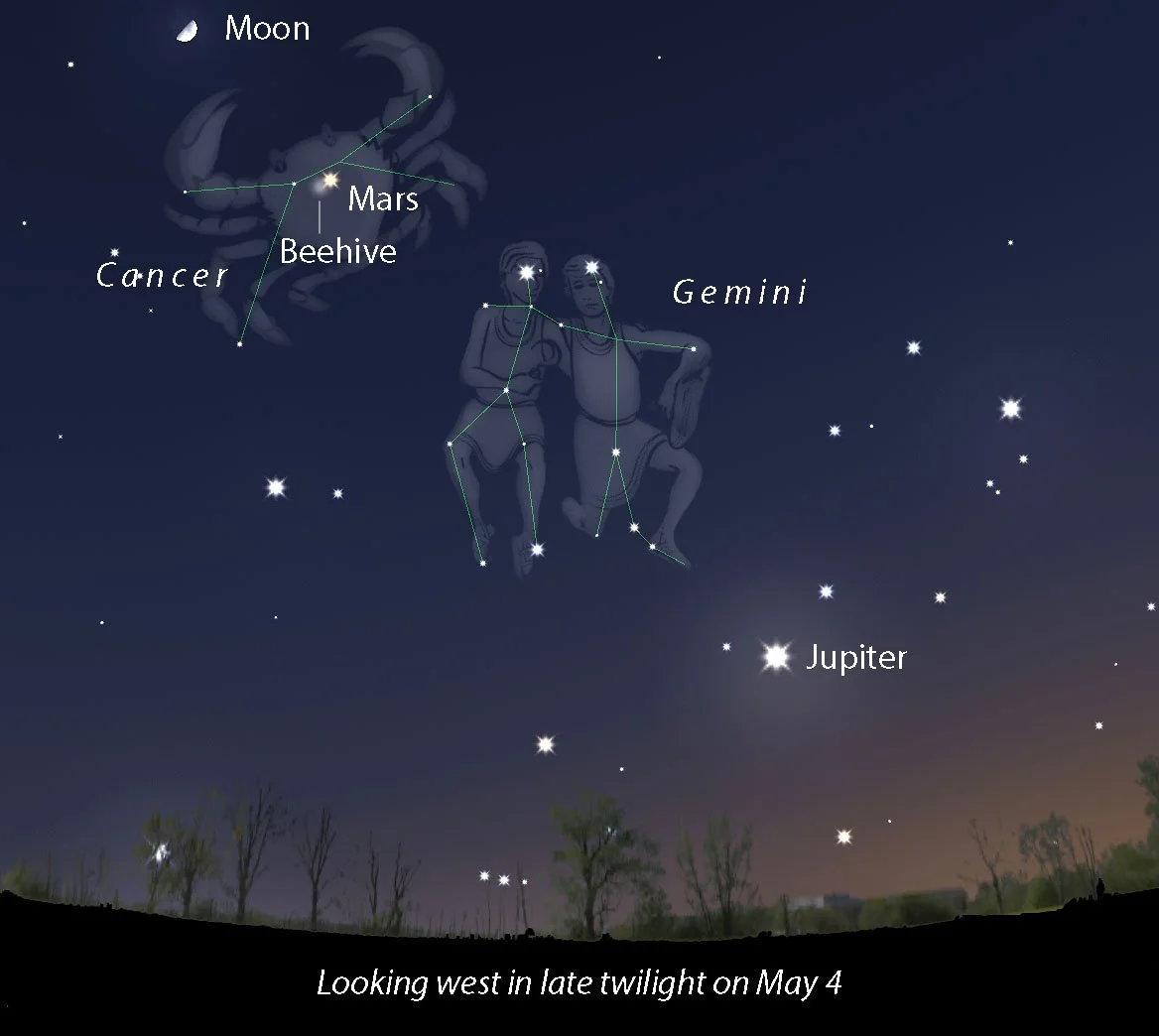
Jupiter sinks ever lower in the northwestern sky until twilight overtakes it at month’s end. Mars stands higher in the west, but its glory days of rivaling Sirius are long over. Still, at first magnitude it remains an easy target. The Red Planet quickly moves east across the faint constellation Cancer as if running from the sun, and enters Leo on May 25.
Saturn climbs higher at dawn but still tussles with twilight. At mid-month it’s about a fist to the right (west) of Venus. Look for both in the eastern sky 90 minutes to an hour before sunrise. Saturn slowly separates from Venus during May and gradually climbs higher into a darker sky.
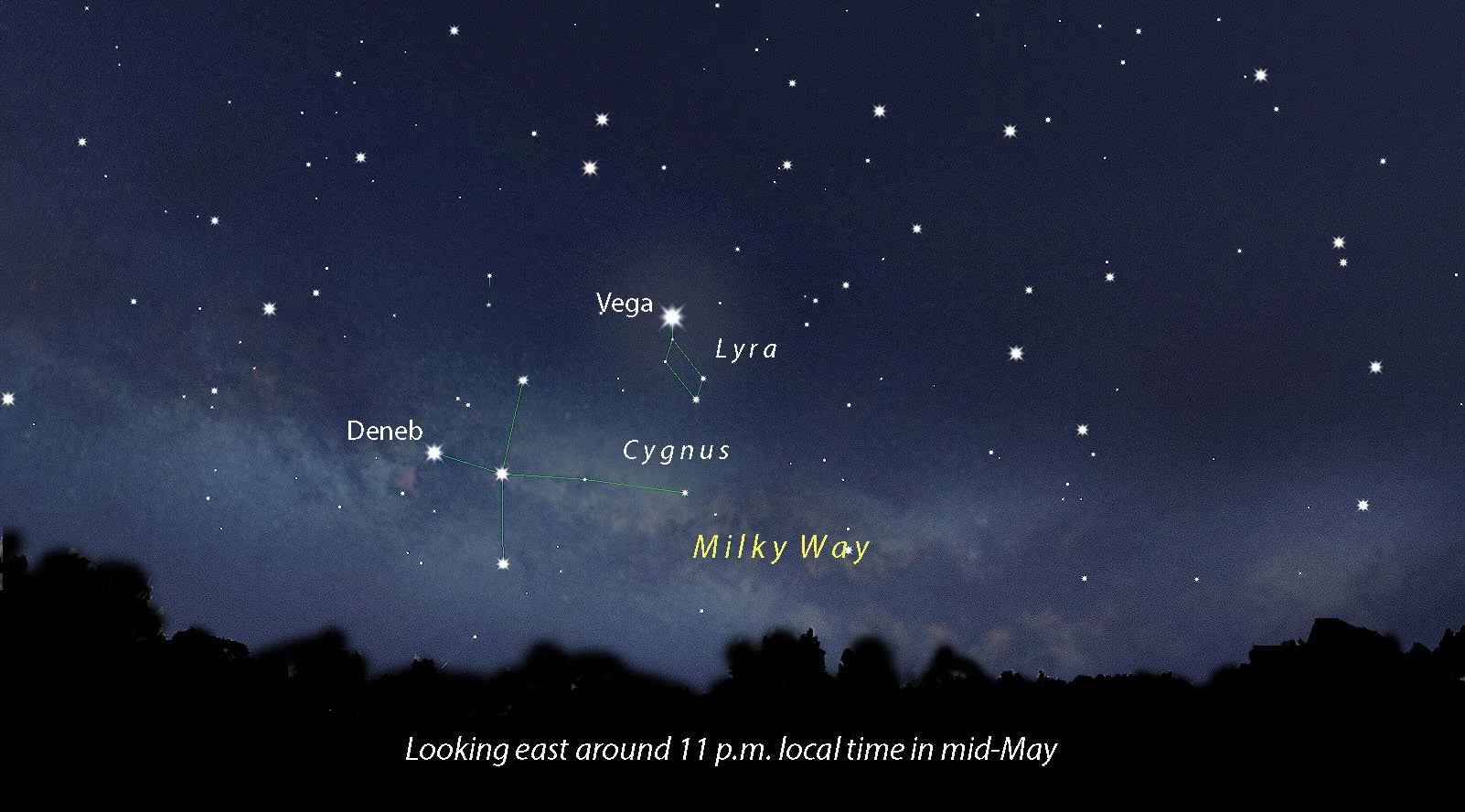
During the last two weeks of May, when the moon’s out of the sky, you may notice a faint bank of “clouds” extending from north to south across the bottom of the eastern sky. That’s no cloud but rather the return of the summertime Milky Way, one of my favorite nighttime sights. It starts climbing up the eastern sky as soon as it gets dark. The hazy band is particularly bright and obvious about a fist below the twinkly-bright star Vega in Lyra.

Our featured constellation is a compact trapezoid of stars called Corvus the crow. It’s out all month low in the southern sky during evening hours. To find it, start at the Big Dipper’s handle, located almost overhead. Follow the arc of the handle to Arcturus, then continue the arc to Spica. Corvus sits a short distance below and a little to the right of Spica.
According to Greek myth, as Apollo was preparing to make a sacrifice to Zeus, he asked Corvus to fetch him some water from a spring. The crow grabbed a cup with its talons and flew off. Along the way, Corvus noticed a tree laden with unripe figs. Instead of focusing on his appointed task, he waited for the figs to ripen so he could eat them, leaving Apollo to find water on his own.
His belly now full, the crow snatched a water-snake along the way and flew back with the empty cup. When Apollo confronted Corvus, the crow blamed the snake for blocking the entrance to the spring. The god saw through the ruse and condemned the crow to a life of thirst – apparently the reason why crows have raspy voices. As a memorial to the story, Apollo placed Corvus, Hydra (the water-snake), and Crater (the cup) in the sky as constellations.
Download the free Stellarium Mobile app for Android and iPhone to help you find and identify the current planets and constellations. Do a Google search, then install the app, set it in night mode (red screen) and point your phone skyward. For a free May sky map and calendar go to www.skymaps.com/downloads.html
May 2025 Night Sky Happenings
Events (a.m. indicates the event happens in the morning sky):
May 3 – Moon shines just above Mars. With binoculars, look for a sprinkle of stars just to the left of the planet. That’s the Beehive star cluster, located 600 light-years from Earth.
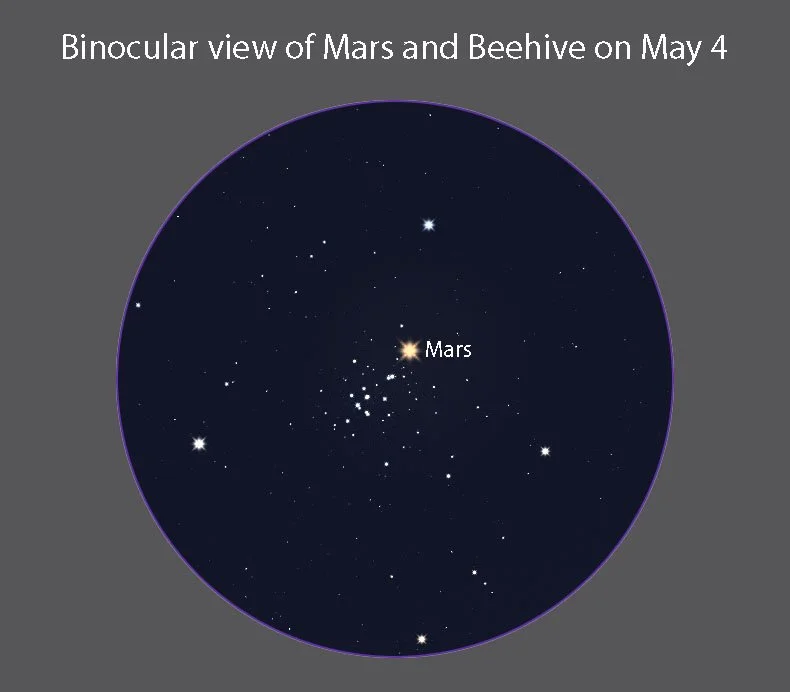
May 4 – First quarter moon. At this phase, the half-moon stands high in the southern sky at sunset. Tonight, Mars will cross the northern edge of the Beehive.
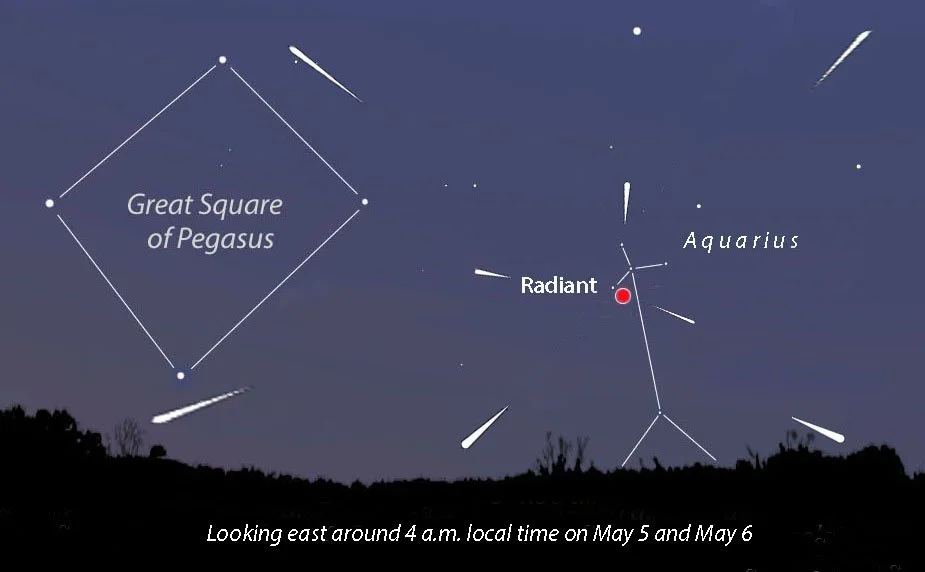
May 5 and May 6 (a.m.) – Peak of the annual Eta Aquariid meteor shower, which originates from Halley’s Comet. Best viewing time will be in the morning from around 3-4:30 a.m. local time. Up to 15-20 meteors per hour will stream from the southeastern sky. Light from the half-moon off to the west will compromise the shower somewhat but not too much.
May 5 – Waxing gibbous moon shines a few degrees to the left (east) of Leo’s brightest star, Regulus.
May 8-26 – Multiple evening and morning passes of the International Space Station (ISS). On a couple nights, the ISS will make up to five passes – one about every 90 minutes − from dusk till dawn. For a complete list of crossing times for your city, log in to Heavens-Above.com, select your location and then click the blue ISS link. Or download and install NASA’s Spot the Station app at the app store or Google Play.
May 9 – An even fuller, brighter gibbous moon stands less than 2 degrees to the right of Spica, Virgo’s brightest star.
May 12 – Full Flower Moon. Rises around local sunset and sets the next morning around sunrise. Named for the spring flowers that make a walk in the woods a joy this time of year.
May 14 – In its third of three bright-star-visits, the waning gibbous moon will shine just one degree below Antares, the brightest star in Scorpius late tonight.
May 22 (a.m.) – Thick lunar crescent shines about 4 degrees to the upper right of Saturn around the start of dawn.
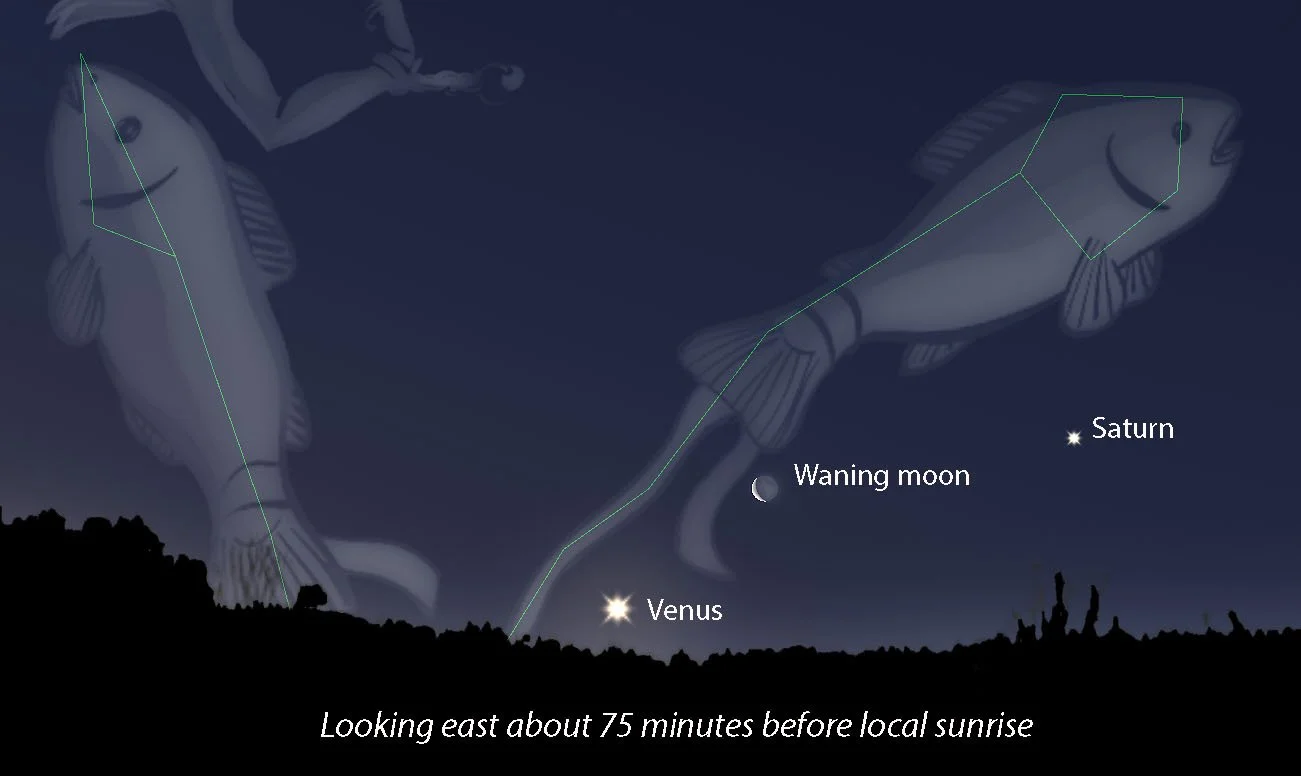
May 23 (a.m.) – Crescent appears roughly midway between Saturn and Venus at dawn.
May 26 – New Moon. The moon lies in the same direction as the sun and is invisible in the daytime sky.
May 27 – Super-thin crescent moon returns to the evening sky. See it from 40 minutes to an hour after sunset. Jupiter shines a little less than a fist to the left and slightly above the moon. It may be your last, easy chance to see the gas giant planet before it disappears in the solar glow.

Bob King is an amateur astronomer, author, and passionate educator. He served as a photographer and photo editor at the Duluth News Tribune for 39 years and taught at the UMD planetarium. Bob’s work had a great impact on Voyageurs National Park. To achieve International Dark Sky Park certification, the park was required to host dark sky education events. Through the Night Sky Explorer webinars, the Conservancy was able to fulfill this component and help secure the certification for Voyageurs National Park. We can’t thank Bob King enough for sharing his talents and knowledge with the Conservancy community to support dark sky preservation.
