
July nights are brief just like June’s, but that’s slowly changing. On July 2 the sun will set 1 minute earlier than it has since June 20. And by month’s end we’ll have gained an additional 24 minutes of evening darkness. I’m looking forward to reclaiming some lost sleep.
With Jupiter hidden in the solar glow, Venus stands alone in the western sky at dusk. It remains low but bright and easy to spot all month 1-2 hours after sunset. Next up is Saturn. The Ring King rises in Pisces in the southeast around 1 a.m. local time on July 1. By month’s end it’s up at 11:30 p.m.
Mars pokes into view around 3 a.m. on July 1 and 2 a.m. on July 31. The Red Planet spends July in Taurus the Bull not far from the Pleiades and Aldebaran. While no major astronomical events mark the month, there will be an exceptionally close conjunction of Mars and Uranus at dawn on July 4. Set your alarm to celebrate this special day astronomically.
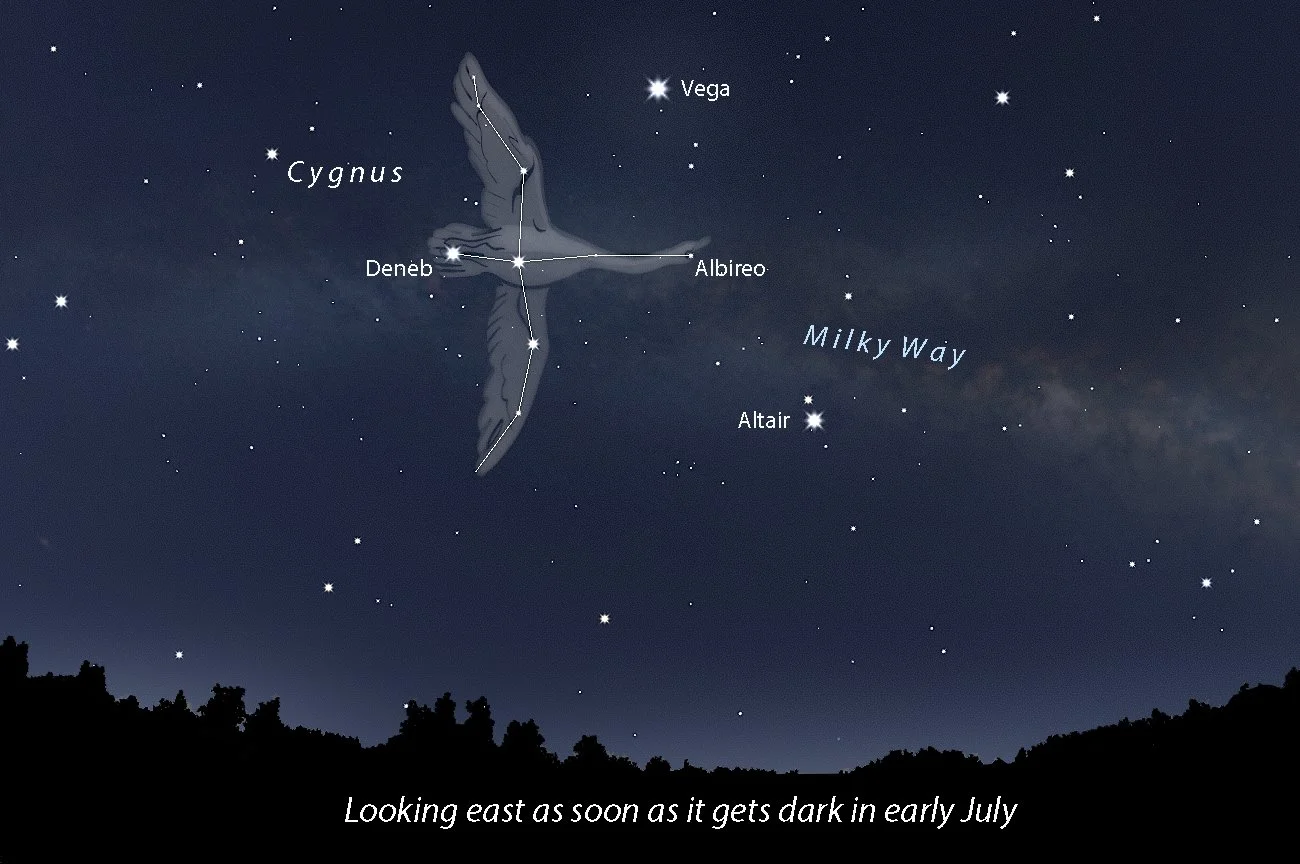
Our featured constellation is Cygnus the Swan, the brightest stars of which outline the Northern Cross asterism. In Greek mythology it represents a swan, wings opened wide flying south down the summer Milky Way. As the story goes, Zeus assumed the form of a swan to pursue one of his many love interests. The brightest star Deneb, at the head of the cross (or tail of the swan) is a blue supergiant some 2,000 light-years away. It’s fantastically luminous, possibly as much as 200,000 times the sun’s brightness and 19 times as massive. Albireo, at the foot of the cross, is a bright, colorful double star for small telescopes.
Download the free Stellarium Mobile app for Android and iPhone to help you find and identify the current planets and constellations. It will also display Jupiter’s moons, which can help you track them down with binoculars or a telescope. Do a Google search, then install the app, set it in night mode (red screen) and point your phone skyward.
For a free July 2026 sky map and calendar go to www.skymaps.com/downloads.html. For updates, aurora alerts and news, check out my Facebook at https://www.facebook.com/astrobobking.
Events (a.m. indicates the event happens in the morning sky)
July 2-24 – The International Space Station makes multiple late evening and early morning passes — up to five a night! For a complete list of flyovers for your city, log in to Heavens-Above.com, select your location and then click the blue ISS link. Or download and install NASA’s Spot the Station app at the app store or Google Play.
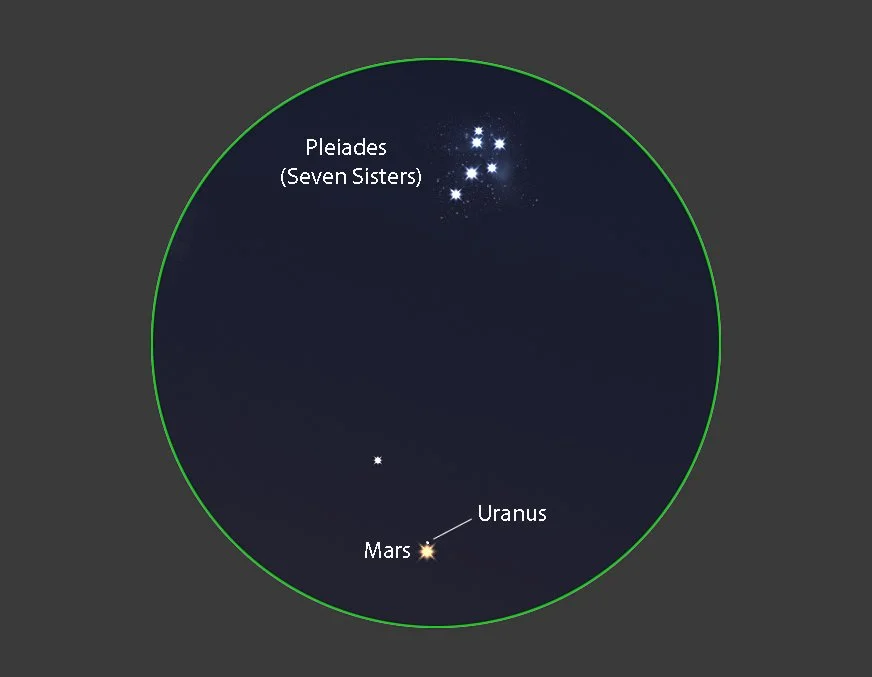
July 4 (a.m.) – Mars slides directly under the planet Uranus at the start of dawn. The two will be just ¼ of a full-moon-diameter apart. Just point your binoculars at Mars and look immediately above it for a tiny star − that’s Uranus! Finding the seventh planet doesn’t get much easier.
July 6 – Earth reaches aphelion, when it’s farthest from the sun for the year at 94.5 million miles. On Jan. 3 at perihelion, it was 3 million miles closer. The difference is caused by Earth’s elliptical orbit.
July 7 (a.m.) – Last quarter moon. Rises around midnight. Look for Saturn just below the moon if you’re up between 2 a.m. and dawn.
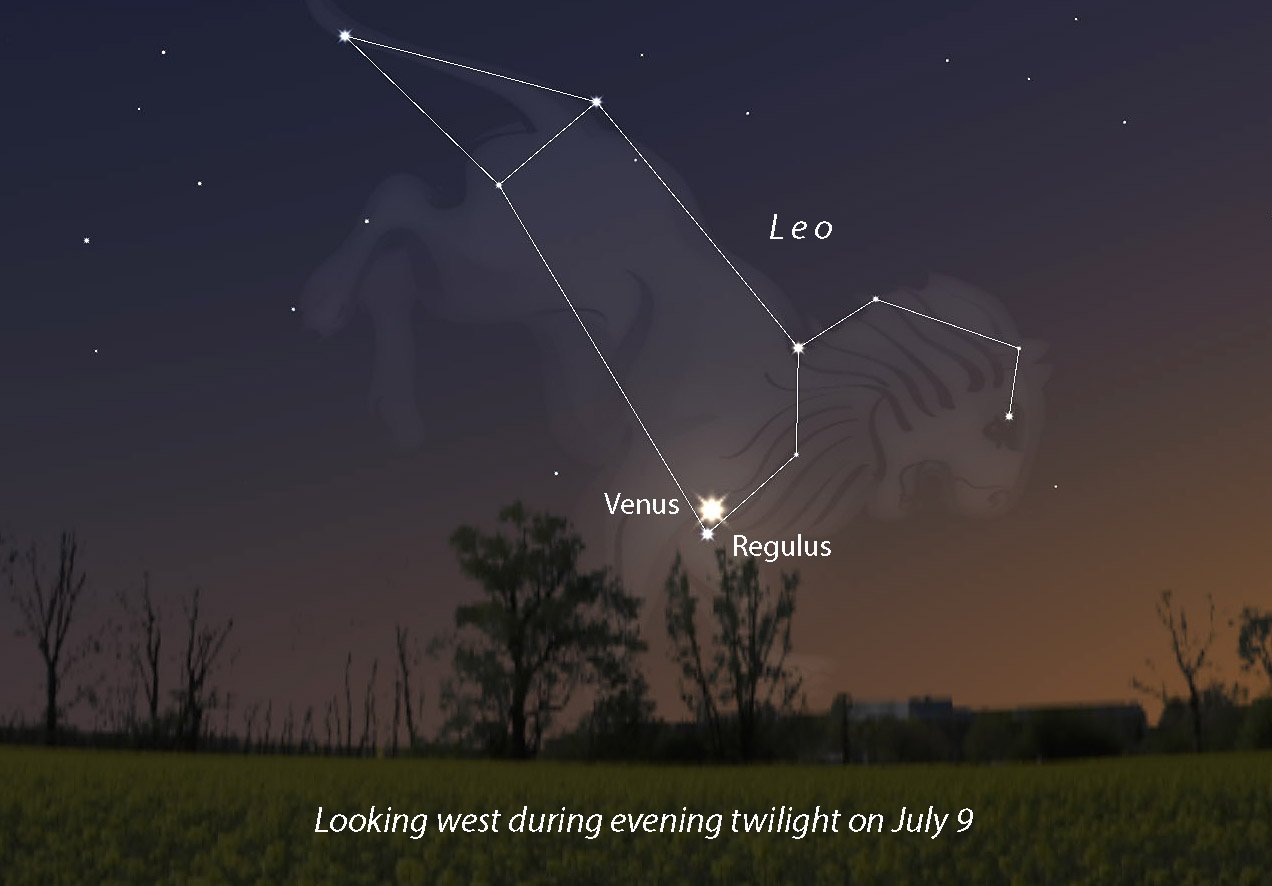
July 8 and 9 – Venus passes very close to Regulus, Leo’s brightest star, at dusk low in the western sky. The two will be just about 1 degree apart on both nights.
July 8-20 – China’s Tiangong space station makes nightly passes at dusk across the southern sky. For a complete list of flyovers for your city, log in to Heavens-Above.com, select your location and then click the blue Tiangong link.
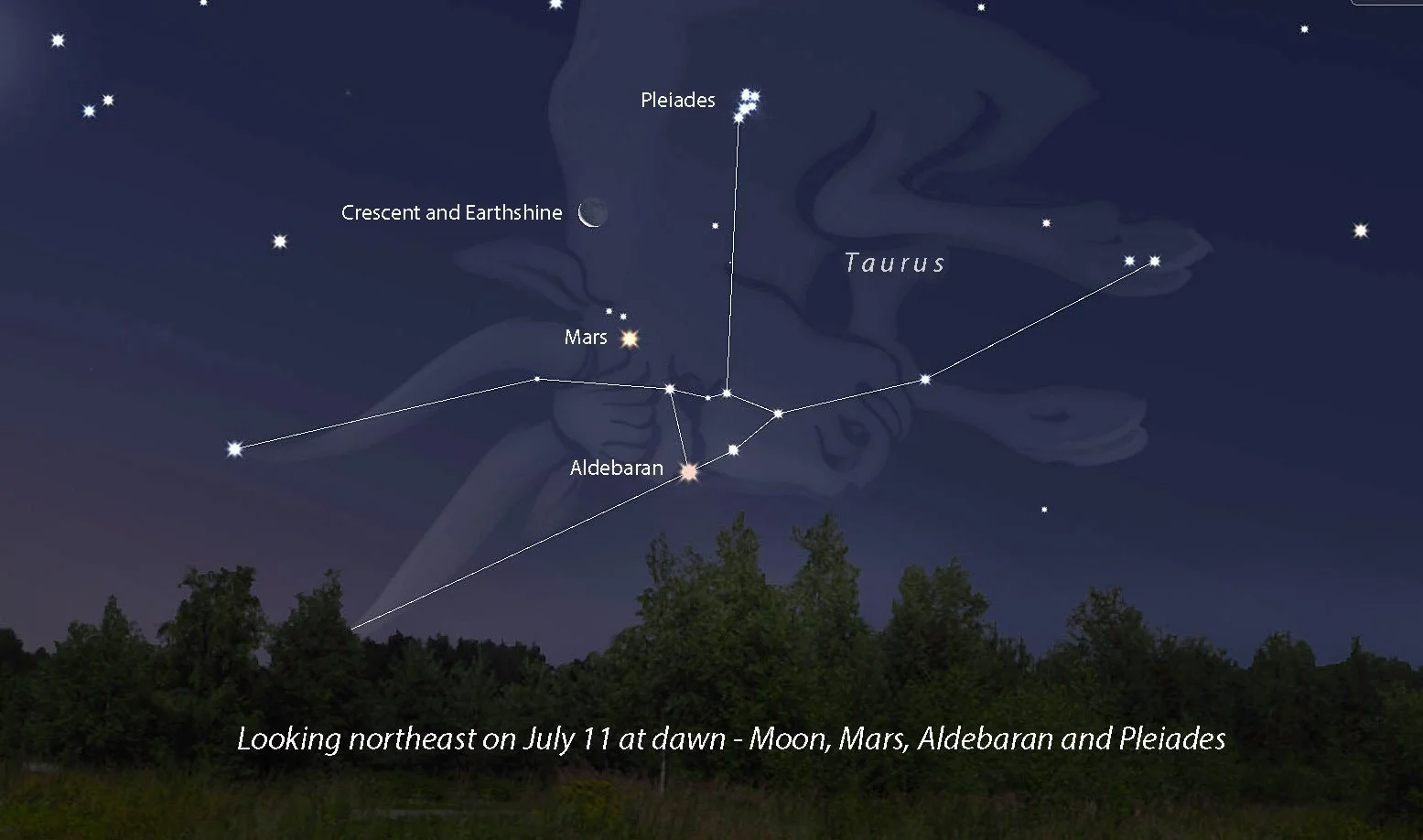
July 11 (a.m.) – Crescent moon, Mars and Aldebaran, the brightest star in Taurus, line up in a row low in the northeastern sky in early dawn. Both Aldebaran and the planet glow red-orange and are similarly bright.
July 13 (a.m.) – Chance to see an exceptionally thin, old moon at dawn. Look very low in the northeastern sky about 50 minutes before sunrise. Use binoculars to help spot it.
July 14 – New moon
July 16 – Thin sliver of moon shines just 1.5 degrees below and left of Regulus with Venus nearby.
July 21 – First quarter moon shines low in the south at sunset.
July 24 – Waxing gibbous moon shines to the lower left (east) Antares, the brightest star in Scorpius the Scorpion.
July 29 – Full Buck Moon rises around sunset in Capricornus the Sea-goat and shines all night.
Go to https://www.timeanddate.com/moon/ to find your local moonrise time.