
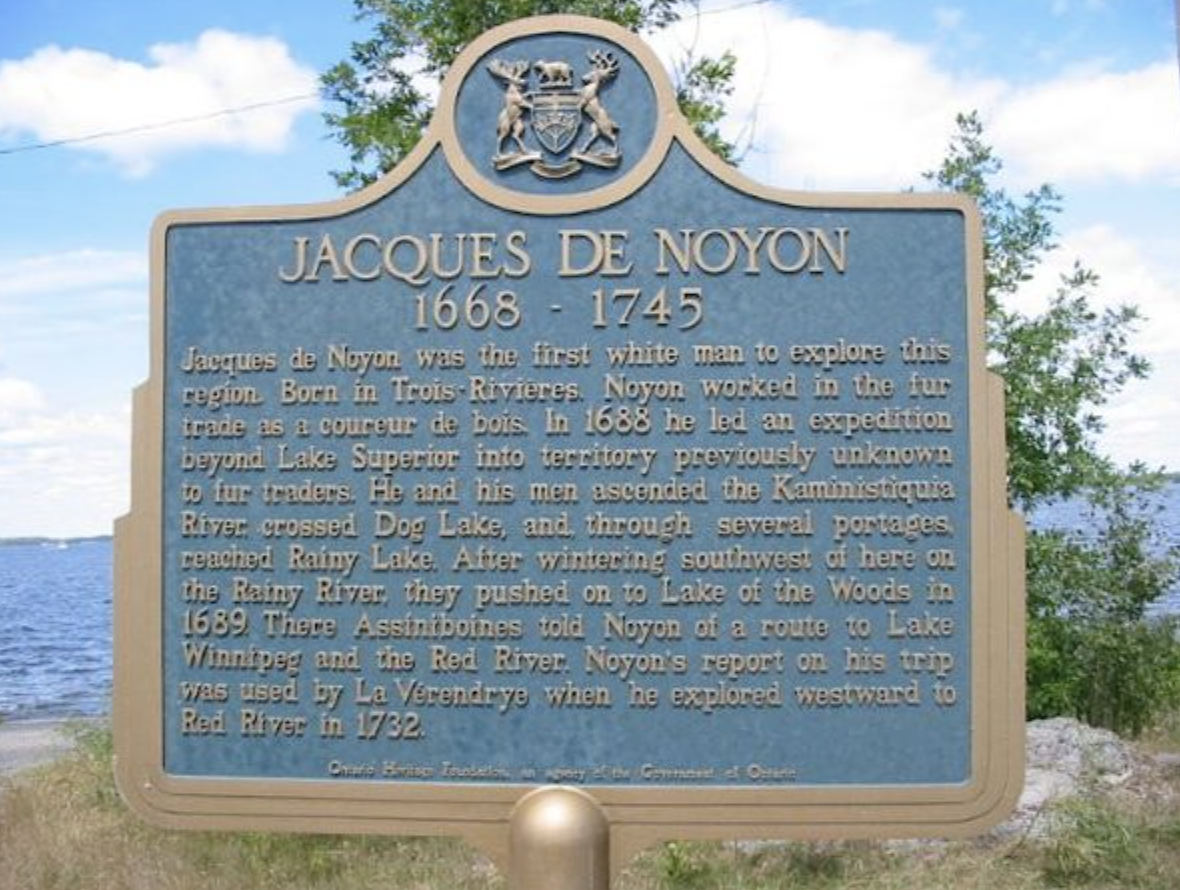
Photo courtesy of the Dictionary of Canadian Biography.
When most people visit Voyageurs National Park, they think of the voyageurs: the hardy French-Canadian paddlers who carried furs and trade goods across the North American interior. It is in the name, after all. But long before the fur brigades turned the lakes and rivers into a superhighway of commerce, one early explorer traveled this wilderness and recorded what would become one of the first European accounts of the region. His name was Jacques de Noyon.
Jacques de Noyon was a French-Canadian explorer born in Trois-Rivières, New France (modern day Quebec) in 1668. Although not as widely known as Samuel de Champlain or Pierre Gaultier de Varennes, he played a pivotal but quiet role in the early exploration of what is now northern Minnesota and western Ontario.
In 1688, at just 20 years old, he embarked on an ambitious journey that would take him from Lake Superior deep into the interior into Rainy Lake, and from there toward the Canadian prairies. His route would eventually become the backbone of the voyageur network, and centuries later, the heart of Voyageurs National Park.
His trip required numerous portages and river ascents, and many of which remain recognizable features in the park’s geography today. As he passed through the waterways that now define Voyageurs National Park, he became the first European known to establish trading routes and have contact with Indigenous peoples in the area.
His observations painted a picture of vast forests, rich wildlife, and interconnected lakes, resources that would later draw thousands of voyageurs, traders, and Indigenous peoples together. He wintered with local Indigenous communities, forging relationships and learning from their knowledge of the land. These interactions and the skills of these people were essential not only to his survival, but also contributed to the mapping of the region using what Indigenous peoples knew about the land.
Despite the significance of his journey, English-French tensions in the late 1600s halted further European travel west of Lake Superior. It wasn’t until the 1730s that La Vérendrye re-entered the Boundary Waters region, likely informed at least in part, by knowledge preserved from de Noyon’s travels more than four decades earlier.
Jacques de Noyon never became a household name. But his 1688 expedition opened a window into a region that would later become one of the most iconic areas of the North American fur trade, and eventually, one of America’s beautiful national parks.
After his early expedition, de Noyon continued to travel throughout New France and New England as a trader and coureur des bois. In 1704, he married Abigail Stebbins in Deerfield, Massachusetts, where he was living during the 1704 Raid on Deerfield. Both he and his wife were captured and taken back to Canada. He later served as a soldier at Fort Pontchartrain du Détroit (Detroit), eventually rising to the rank of sergeant. Jacques de Noyon died on May 12, 1745, in Boucherville, Quebec.
So the next time you find yourself gliding across a calm lake in Voyageurs National Park, imagine a young French-Canadian explorer doing the same more than 330 years ago, guided by Indigenous expertise, curiosity, and the pull of the unknown.
Check out the full list of our 50 legacies!
This year, we’re celebrating 50 years of Voyageurs National Park by sharing 50 inspiring stories of the people who shaped its legacy. Years, 50 Legacies is a yearlong storytelling series highlighting individuals whose lives are woven into the fabric of the park – whether through conservation work, cultural traditions, recreation, research, or personal connection.
Raise a canteen and celebrate this historic milestone with us at our 50th anniversary website. Don't forget to subscribe to our newsletter for more inspiring stories and updates!
