
February 2026 Night Sky Calendar
By Bob King
Are you making it through winter? Is there any choice? There’s still no better season for bright stars, which now congregate with brilliant Jupiter in the southern sky. Saturn is still with us, low in the southwestern sky at dusk. Below it you’ll find horizon-hugging Venus, a fresh face in the evening sky. By mid-month it’s visible about 20 minutes after sundown very low in the west with binoculars and about 30 minutes at month’s end.

Mercury makes a fine appearance at dusk not far from Venus. It will be easier to spot because it’s higher up and easier to see. The smallest planet and closest to the sun pops into view during the first week of February. But the most exciting time to see it will be on Wednesday, Feb. 18. That evening, Mercury will be in close conjunction with the thin crescent moon. Together with Venus and Saturn, the celestial foursome will cluster together low in the western sky. If you wait till it’s a little darker, you’ll find an additional planet in the group – Neptune. It will be less than a degree to the upper right (north) of Saturn.
Despite the winter constellations’ sway, new groups are pushing up in the east. Watch for the bright constellation Leo the lion, which really does look like a stick-figure lion, padding up the eastern sky around 9 p.m. local time. The Big Dipper is also ascending, and stands on its handle high in the northeastern sky at the same time.
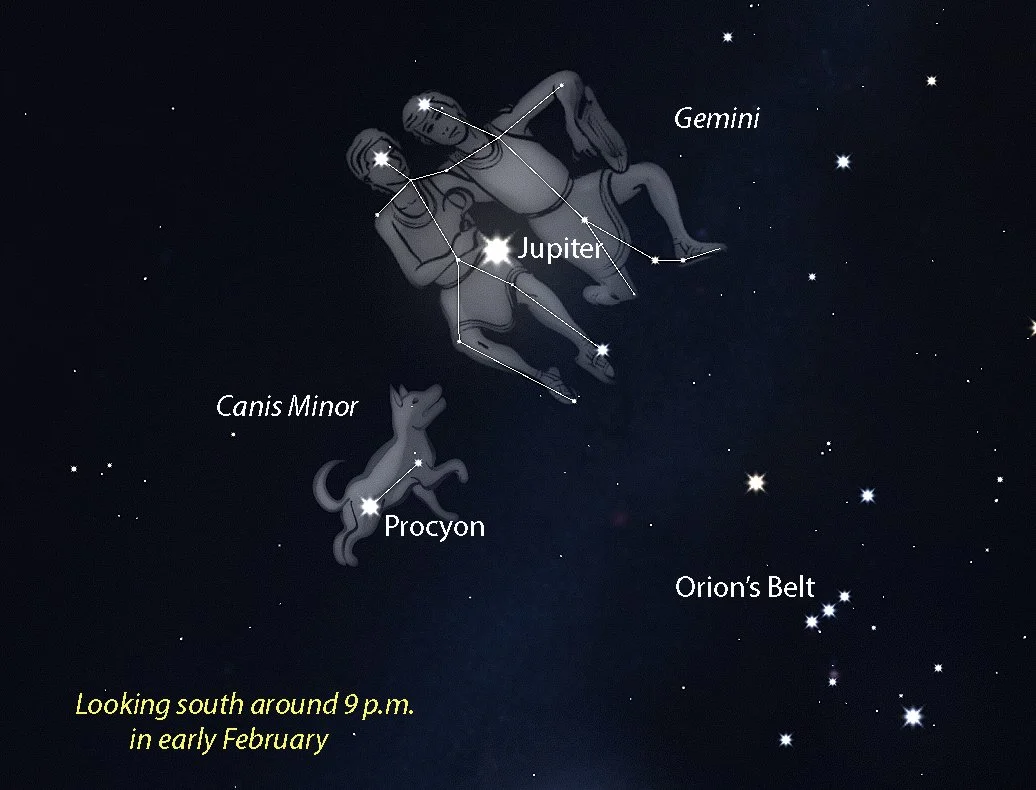
Our featured constellation is Canis Minor the Lesser Dog, which stands high in the southeastern sky below the bright planet Jupiter around 9 p.m. This simple constellation, comprised of two stars, looks more like a stick you’d play fetch with than a dog. According to ancient Greek myth, Canis Minor and his bigger brother, Canis Major the Greater Dog, accompanied Orion on his many hunts.
Procyon, the little pup’s brightest star, is one the closest stars in the nighttime sky, located just 11.5 light-years away. It’s also a close binary star. Its name means “before the dog” (pro-cyon) because Canis Minor rises before Canis Major.
Download the free Stellarium Mobile app for Android and iPhone to help you find and identify the current planets and constellations. It will also display Jupiter’s moons, which can help you track them down with binoculars or a telescope. Do a Google search, then install the app, set it in night mode (red screen) and point your phone skyward. For a free February 2026 sky map and calendar go to skymaps.com/downloads.html. For updates, aurora alerts and news, check out my Facebook at facebook.com/astrobobking.
Events (a.m. indicates the event happens in the morning sky):
Feb. 1 – Full Snow Moon. Rises in Cancer the crab around sunset and shines all night
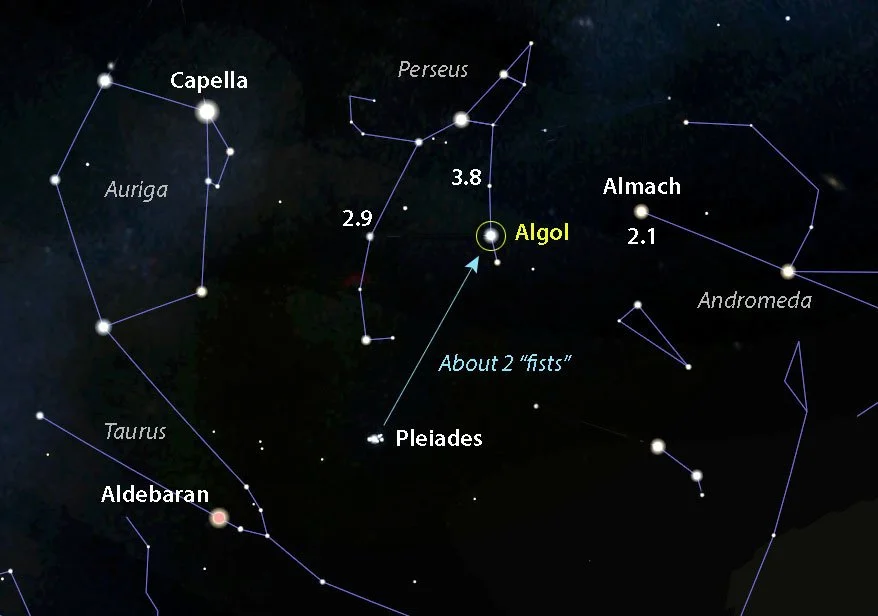
Feb. 1 – Algol the Demon Star dips to minimum brightness around 6:30 p.m. CST as its orbiting companion star eclipses it. Several hours later, as it comes out of eclipse, the star gets bright again. Use the map to locate Algol. When brightest it’s similar to Almach. At minimum it’s closer to Kappa Persei.
Feb. 1-20 – Mercury puts in a nice evening appearance low in the western sky about 45 minutes to an hour before sunset. It’s joined by Venus – newly arriving in the evening sky – very low in the twilight glow. As Mercury moves back toward the sun after mid-month, Venus slowly climbs out of the solar glare. Use binoculars to help you spot either or both.
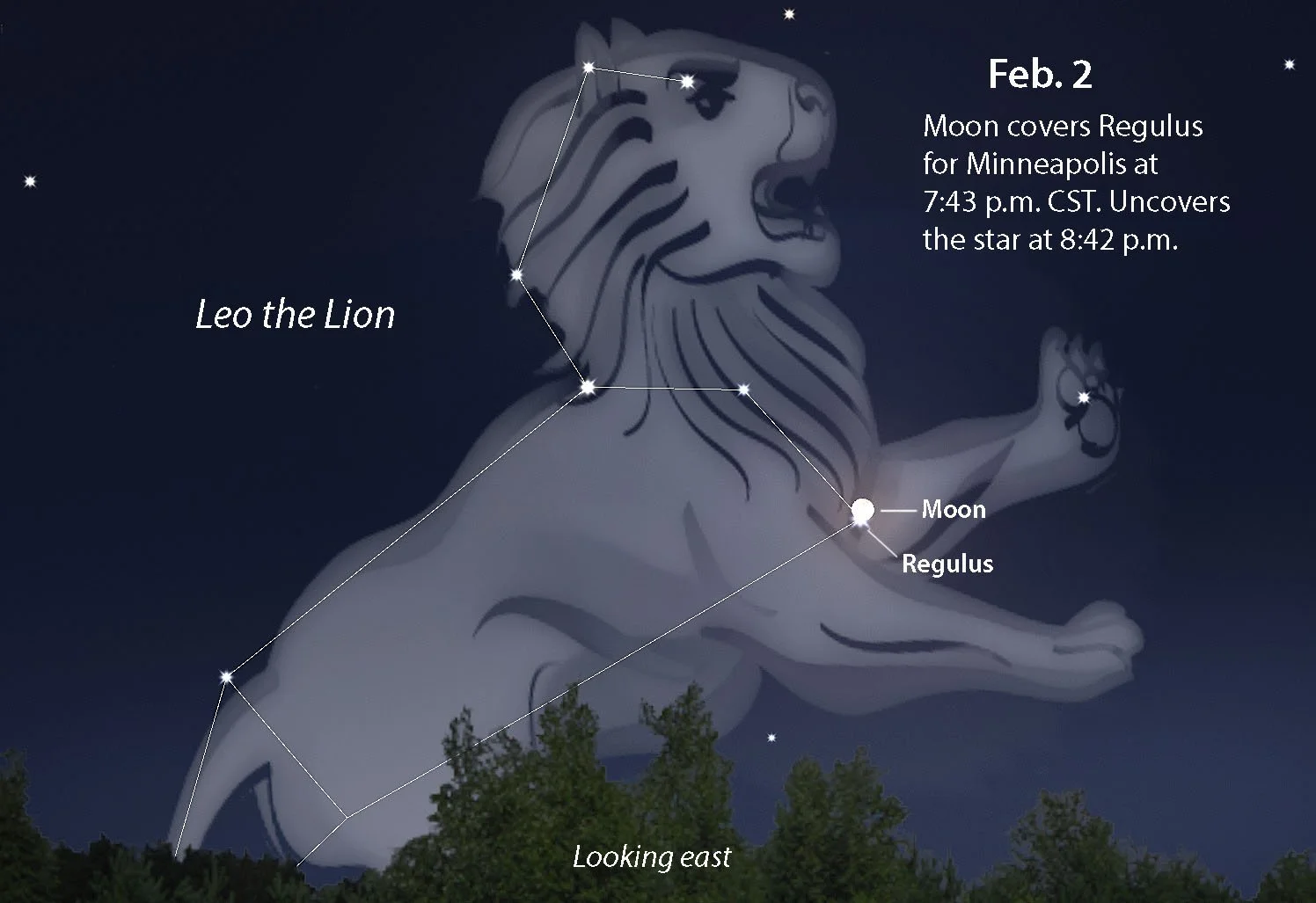
Feb. 2 – Nearly full moon occults Leo’s brightest star Regulus. For a list of times when the moon covers and then uncovers the star, go to lunar-occultations.com/iota/bstar/0203zc1487.htm and scroll up to find your city. The times given are Universal Time (UT), so remember to subtract 5 hours for EST, 6 for CST, 7 for MST and 8 for PST and move the calendar date back one to Feb. 2.
Feb. 7 – Waning gibbous moon shines just below Spica, Virgo’s brightest star
Feb. 9 – Last quarter moon. Rises around midnight and stands due south around sunrise.
Feb. 11-28 (a.m.) – The International Space Station makes passes across the dawn sky. For a complete list of flyovers for your city, log in to Heavens-Above.com, select your location and then click the blue ISS link. Or download and install NASA’s Spot the Station app at the app store or Google Play.
Feb. 11-21 – China’s Tiangong space station makes passes across the southern sky during the early evening hours. Like the International Space Station, it orbits the Earth with a crew of astronauts, but being smaller it looks fainter. For a complete list of pass times for your location, click the blue Tiangong link at Heavens-Above.
Feb. 17 – New Moon. The moon is near the sun in the daytime sky and not visible. There will be an annular solar eclipse this day visible from Antarctica.
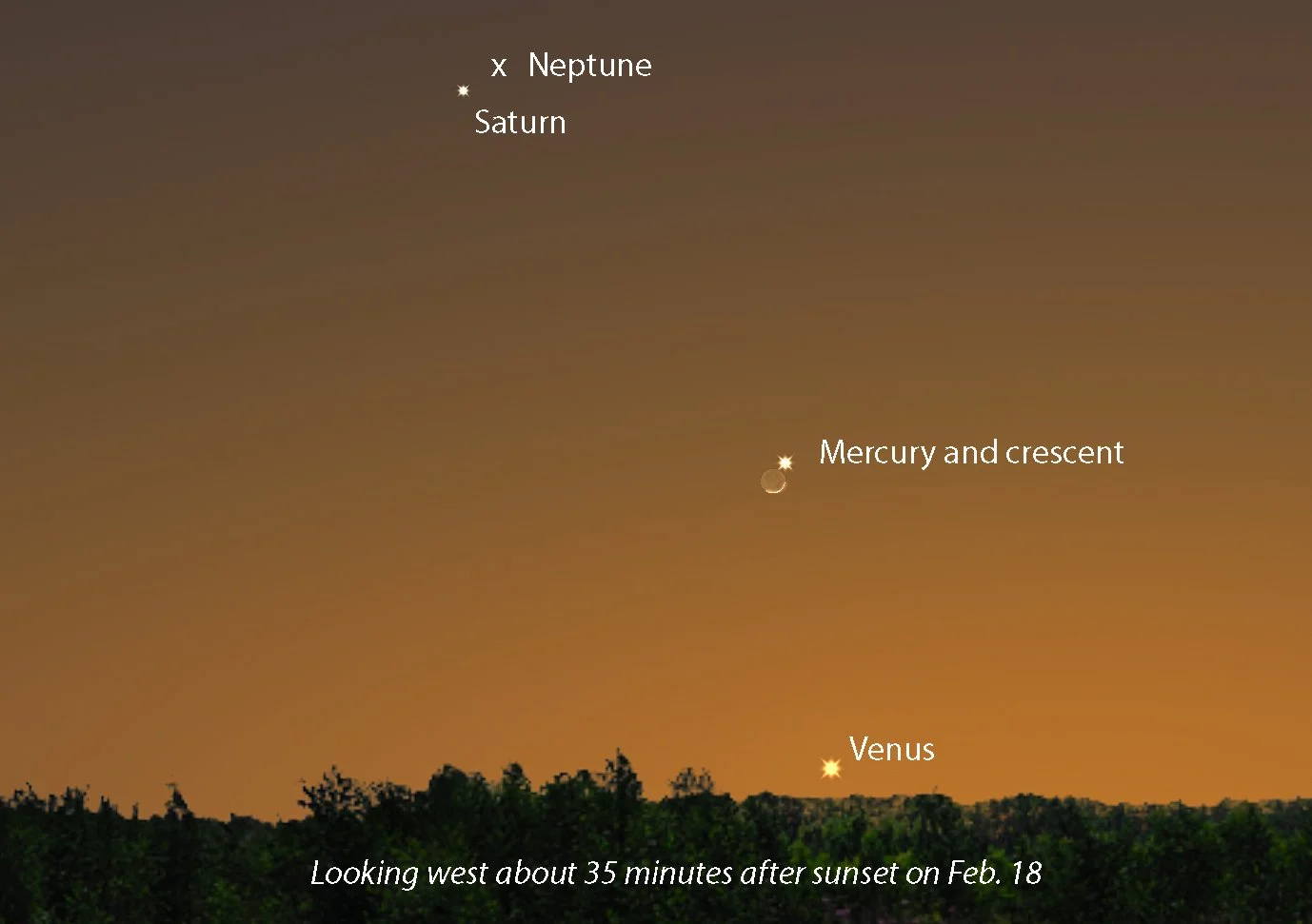
Feb. 18 – Very close conjunction of the thin lunar crescent and Mercury low in the western sky in twilight. The two will be less than half a moon-diameter apart. Mercury has phases just like the moon. Through a telescope magnifying 40x or more, it will look like a half-moon tonight. Saturn appears just above Mercury and Venus below, making for quite the planetary gathering!
Feb. 18 – Algol at minimum brightness around 11:30 p.m. CST. Look as soon as it gets dark to see the star close to peak brightness, then check again around 11-11:30 p.m. to see it in eclipse.
Feb. 19 – Waxing crescent in conjunction with Saturn about 4 degrees to the upper right of the planet
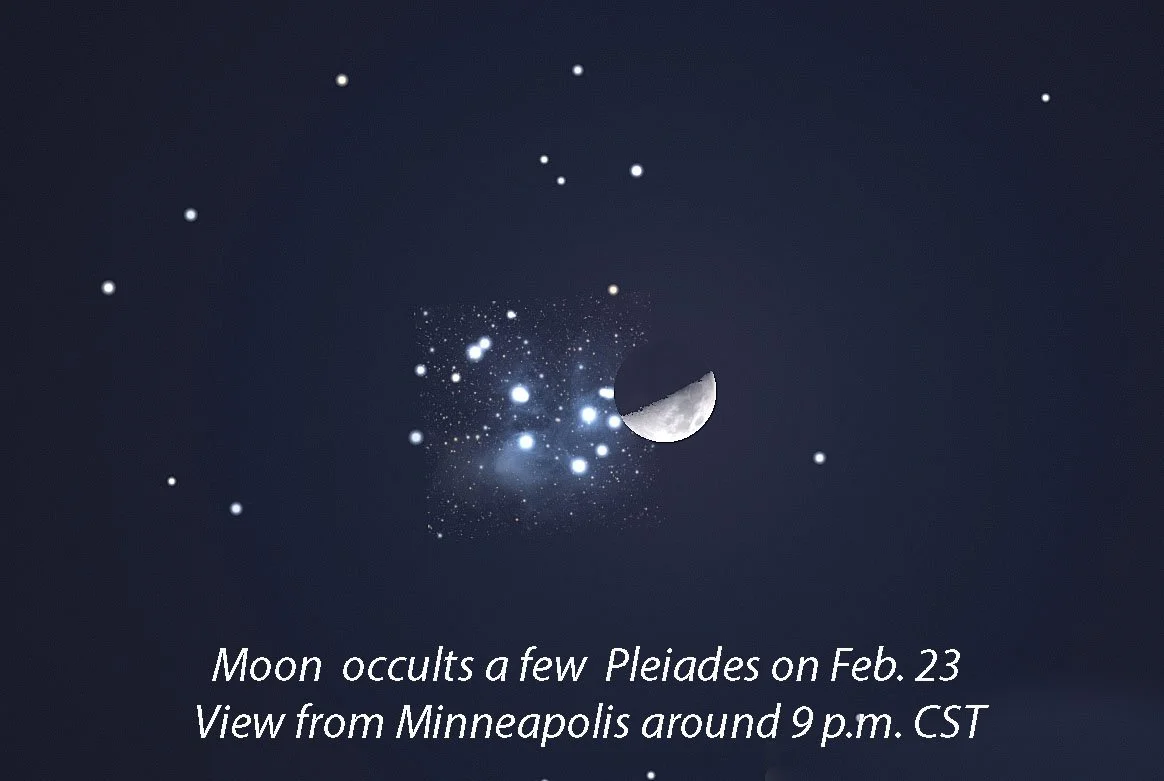
Feb. 23 – For skywatchers in the northern U.S. and Canada the moon crosses the northern part of the Pleiades star cluster for a couple hours starting around 8:45 p.m. CST. Stars will disappear one by one at the moon’s dark edge (left side) and reappear along the bright side.
Feb. 24 – First quarter moon. The moon shines high in the southern sky around sunset.
Feb. 26 – Waxing gibbous moon shines above Jupiter

Bob King is an amateur astronomer, author, and passionate educator. He served as a photographer and photo editor at the Duluth News Tribune for 39 years and taught at the UMD planetarium. Bob’s work had a great impact on Voyageurs National Park. To achieve International Dark Sky Park certification, the park was required to host dark sky education events. Through the Night Sky Explorer webinars, the Conservancy was able to fulfill this component and help secure the certification for Voyageurs National Park. We can’t thank Bob King enough for sharing his talents and knowledge with the Conservancy community to support dark sky preservation.
