
By Bob King
Saturn remains the sole bright evening planet. Venus and Mercury hang near the sun and of our view for northern hemisphere skywatchers. Mars and Jupiter ply the morning sky. Both planets are getting brighter, and they’re also getting closer in preparation for next month’s eye-popping conjunction.
Highlights this month include a rare occultation of Jupiter by the waning crescent moon (Oct. 6, see details below), the annual Orionid meteor shower, which stems from dust and rock shed by Halley’s Comet, and the opposition of Saturn on Oct. 4. At opposition, Earth and the ringed planet are lined up together on the same side as the sun and closest for the year. That’s why right now is the best time toobserve Saturn a telescope.
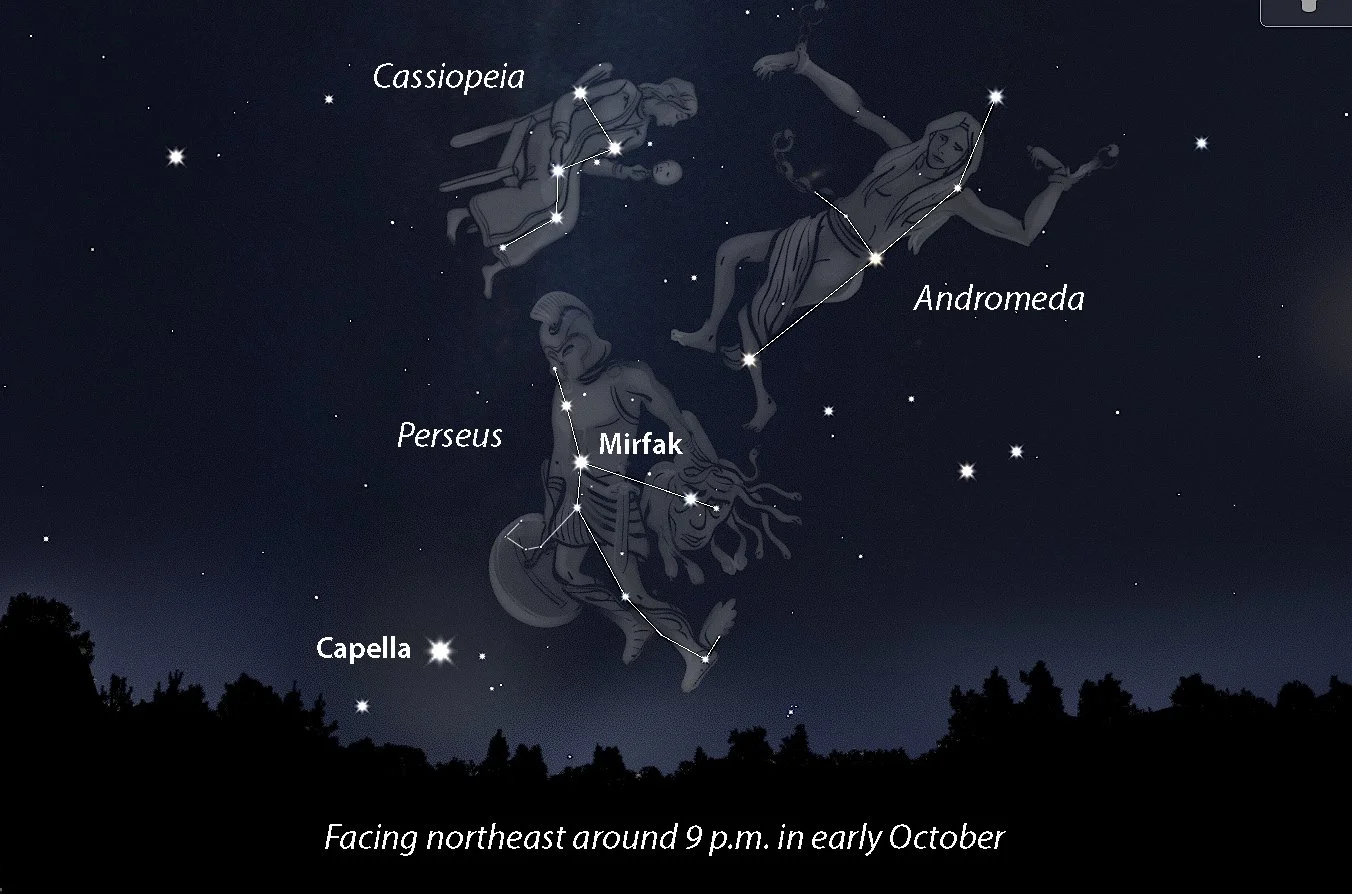
Our featured constellation is Perseus the Hero, located about a fist below the W of Cassiopeia in the northeastern sky. Shaped like the letter J (with two “spokes” of fainter stars extending to the right), Perseus has several moderately bright stars, including Mirfak.
Fresh from lopping off the head of Medusa with a diamond sword, Perseus chanced upon Princess Andromeda chained to a rock in the Mediterranean Sea. As punishment for her mother Cassiopeia’s vanity, Poseidon sent a flood and sea monster (Cetus) to ravage the coast and devour Andromeda. Perseus offered tosave the terrified princess in exchange for her hand in marriage. Both King Cepheus and Queen Cassiopeia agreed. Perseus vanquished the beast and they were married.
Download the free Stellarium Mobile app for Android and iPhone to help you find and identify the current planets and constellations. After you install the app set it to night mode (red screen) and point your phone skyward.
For a free October 2026 sky map and calendar go to www.skymaps.com/downloads.html. For updates, aurora alerts and news, check out my Facebook at https://www.facebook.com/astrobobking.
Events (a.m. indicates the event happens in the morning sky. All times are Central Daylight.)
Oct. 3 (a.m.) – Last quarter moon. Rises around midnight and shines in the south at dawn.
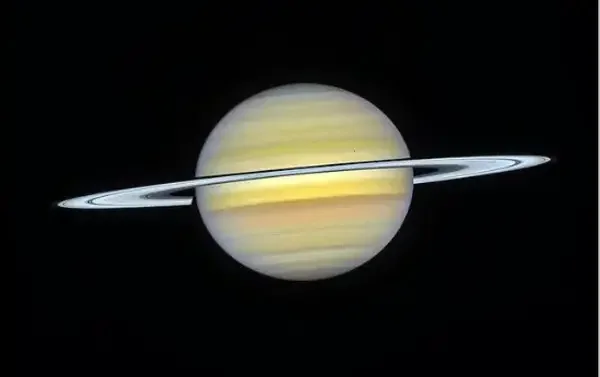
Oct. 4 – Saturn at opposition (opposite the sun in the sky) and closest to Earth for the year at 784 million miles. It rises around sunset in the southeastern sky and shines all night. The rings are tipped open this season and look lovely in a telescope.
Oct. 5 (a.m.) – Waning crescent moon shines close below and left of Mars in the eastern sky just before the start of dawn.
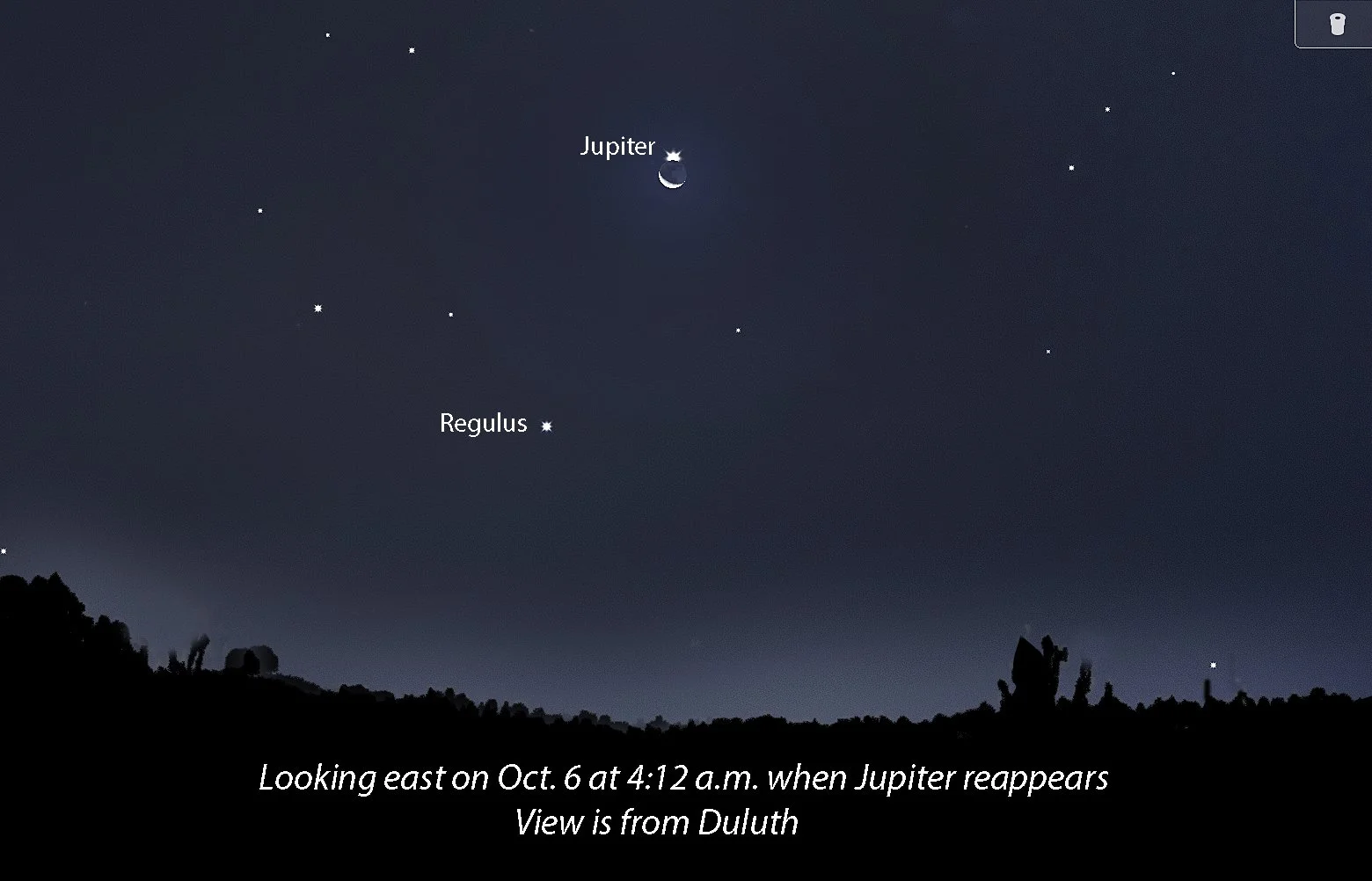
Oct. 6 (a.m.) – Crescent moon covers up Jupiter and its four brightest moons for much of the eastern U.S. The rare event, called an occultation, takes place in the early morning before dawn low in the eastern sky. Make sure you have an unobstructed view in that direction. To find when Jupiter disappears and reappears for your city, go to http://www.lunar-occultations.com/iota/bstar/1006jupiter.htm. Times shown are Universal Time (UT). Subtract 4 hours for Eastern Time, 5 for Central, 6 for Mountain and 7 for Pacific. The occultation will be visible with the naked eye and binoculars.
Oct. 10 – New moon. Moon near the sun in the daytime sky and not visible.
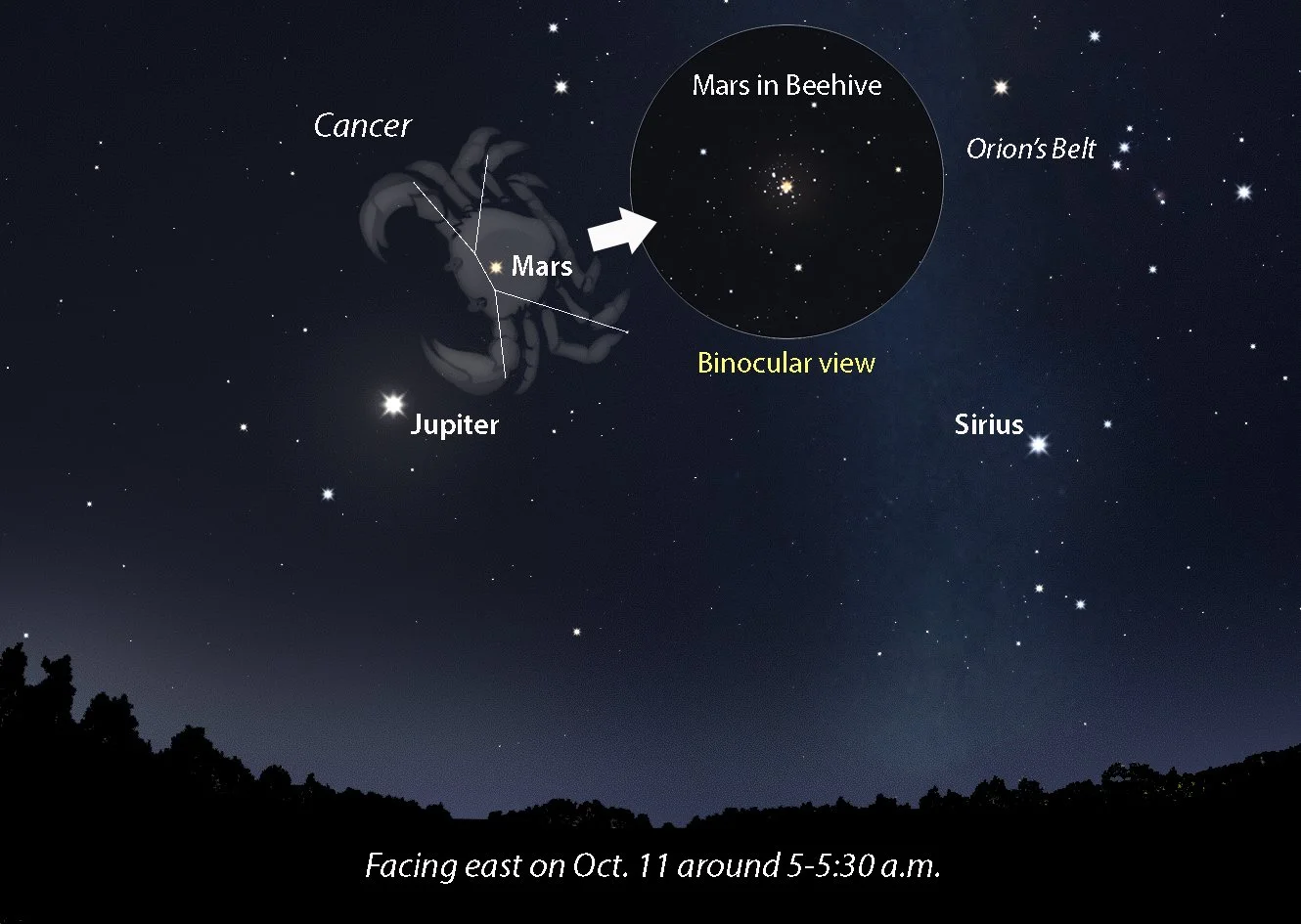
Oct. 11 (a.m.) – Mars smack in the middle of the Beehive star cluster in Cancer. Use binoculars for a great view of the planet surrounded by stars between 3 a.m. and dawn.
Oct. 14 – Waxing crescent moon shines low in the southwest just to the left of Antares in Scorpius about 45 minutes after sunset. Use binoculars to see the pairing best.
Oct. 14-31 (a.m.) – The International Space Station makes 1-2 passes each morning around dawn. For a complete list of flyovers for your city, log in to Heavens-Above.com, select your location and then click the blue ISS link. Or download and install NASA’s Spot the Station app at the app store or Google Play. The ISS looks like a brilliant star moving west to east across the sky.
Oct. 8-22 (a.m.) – Zodiacal light visible as a large, tapered, milky glow standing up from the eastern horizon in a dark sky just before the start of dawn. Similar in brightness to the Milky Way, it’s made of dust shed by comets and asteroids that gathers in the plane of the solar system. Sunlight sets it aglow.
Oct. 18 – First quarter moon shines low in the south at sunset.

Oct. 21-22 (a.m.) – Peak of the annual Orionid meteor shower. Average rate of 20 meteors per hour from a dark sky. Best between moonset (3:15 a.m.) and dawn on Oct. 22.
Oct. 23 – Waxing gibbous moon shines to the right of Saturn all night.
Oct. 24 – Waxing gibbous moon shines to the upper left of Saturn.
Oct. 24–31 – China’s Tiangong space station returns to making evening passes across the southern sky. For a complete list of flyovers for your city, log in to Heavens-Above.com, select your location and then click the blue Tianhe-1 link. The station looks like a bright star moving from west to east.
Oct. 25 – Full Hunters Moon. Go to https://www.timeanddate.com/moon/ to find your local moonrise time.
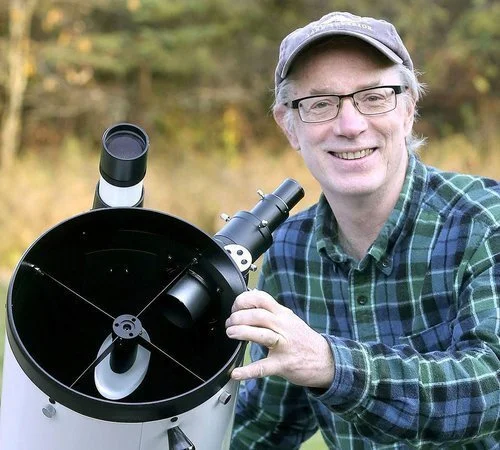
Bob King is an amateur astronomer, author, and passionate educator. He served as a photographer and photo editor at the Duluth News Tribune for 39 years and taught at the UMD planetarium. Bob’s work had a great impact on Voyageurs National Park. To achieve International Dark Sky Park certification, the park was required to host dark sky education events. Through the Night Sky Explorer webinars, the Conservancy was able to fulfill this component and help secure the certification for Voyageurs National Park. We can’t thank Bob King enough for sharing his talents and knowledge with the Conservancy community to support dark sky preservation.