
By Bob King
We now have two planets in the evening and two in the morning. Venus is the first to show. It’s very low in the southwestern sky shortly after sunset. You’ll need an unobstructed view to spot it. When you do, take a look in binoculars, focus carefully, and you’ll see it has a crescent shape just like the moon.
Saturn comes up in the southeastern sky around 9:30-10 p.m. It’s the only bright “star” visible at that time in that direction. Binoculars will show its elongated shape, but you’ll need a small telescope magnifying around 30x to savor the rings.
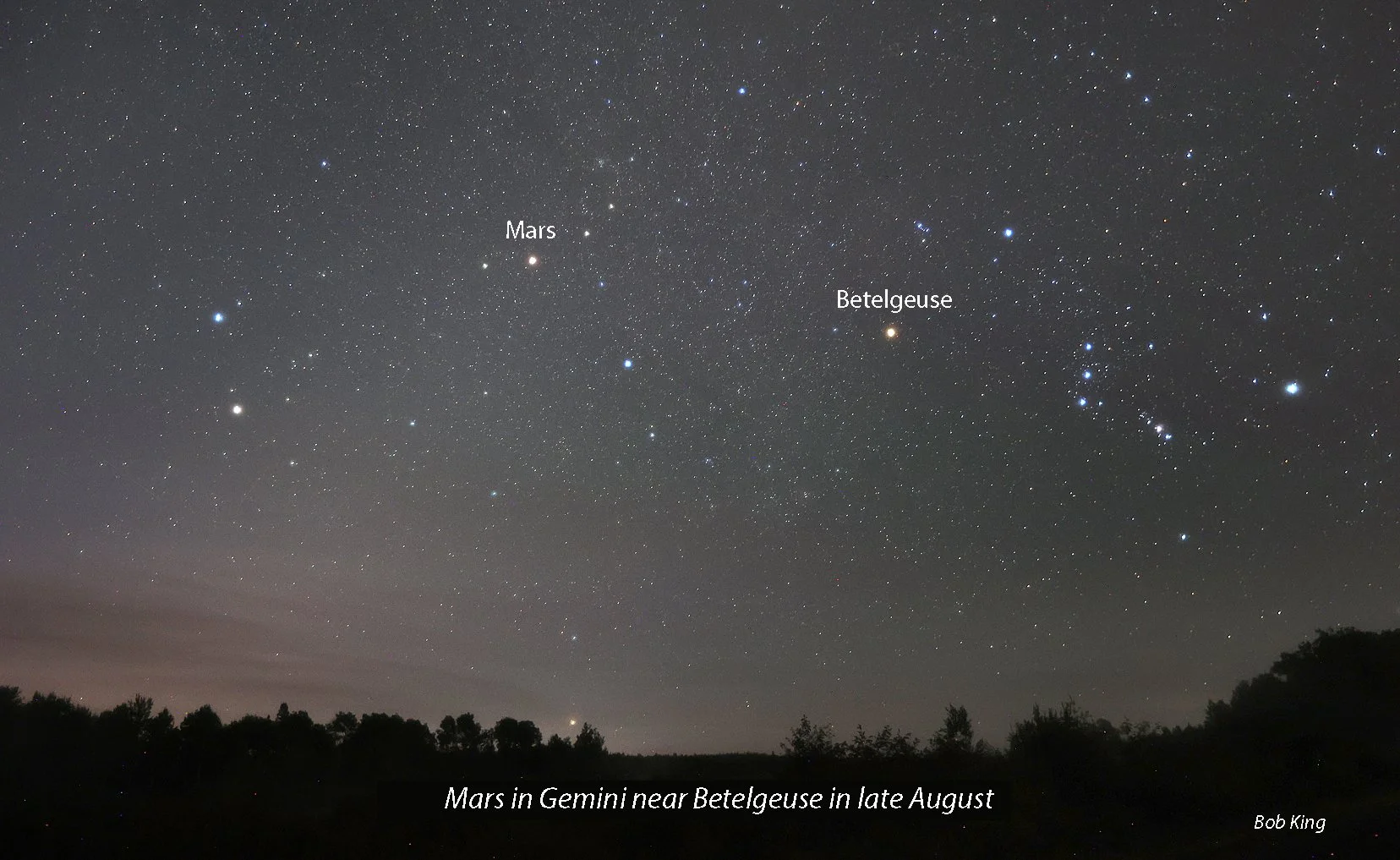
Mars continues to brighten as it slowly climbs higher in the east during the wee hours. On September 1 it sits in the middle of Gemini the Twins. No planet stands still for long, the reason the Red One continues to move east, slipping into neighboring Cancer the Crab on September 25. Meanwhile, Jupiter, located farther east and lower in the sky, crosses from Cancer into Leo the Lion. Mars, the faster planet, will overtake sluggard Jupiter in a pretty conjunction on November 14.
Late summer is the ideal time to view the Milky Way because it’s highest in the sky at the end of dusk. Plan a drive to the country when the moon rises late or thins to a crescent. You’ll seethe hazy band best from September 2-17. The other highlight is the Harvest Moon on the 26th. For several nights, successive moonrises are delayed by only about 20 minutes instead of the usual hour. Our ancestors used that additional early evening moonlight to harvest crops.
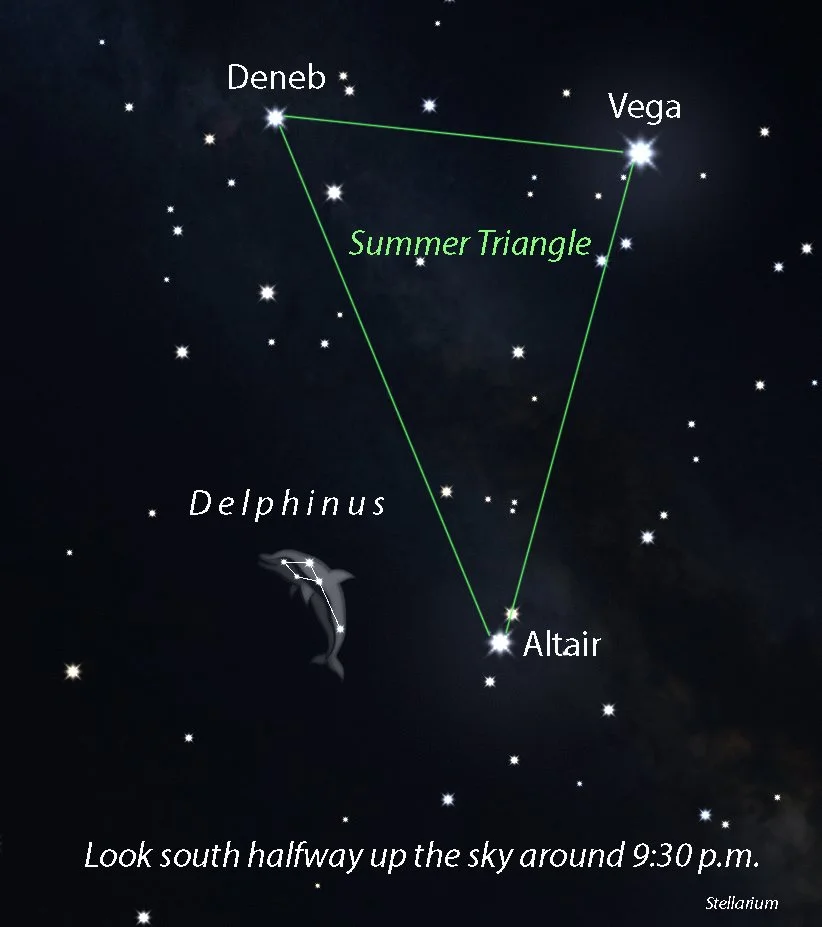
Our featured constellation is Delphinus the Dolphin, located a little more than a fist to the upper left of Altair, the bottom star in the Summer Triangle asterism. Although it has no particularly bright stars, its distinctive shape (it really does resemble a leaping dolphin) and compact form make it easy to find.
According to ancient Greek myth, Poseidon, the god of the sea, sought a wife and had his eyes on Amphitrite, eldest of the sea nymphs, the Nereids. She avoided him, so Poseidon sent a loyal dolphin, who talked her into it by speaking in a soothing and comforting voice. She agreed to the marriage and became the queen of the sea. In gratitude, Poseidon placed the figure of the dolphin in the sky as Delphinus.
Download the free Stellarium Mobile app for Android and iPhone to help you find and identify the current planets and constellations. Do a Google search, then install the app, set it in night mode (red screen) and point your phone skyward.
For a free September 2026 sky map and calendar go to www.skymaps.com/downloads.html. For updates, aurora alerts and news, check out my Facebook at https://www.facebook.com/astrobobking.
Events (a.m. indicates the event happens in the morning sky. All times are Central Daylight.)
Sept. 1-11 – China’s Tiangong space station makes nightly passes at dusk across the southern sky. For a complete list of flyovers for your city, log in to Heavens-Above.com, select your location and then click the blue Tianhe-1 link. The station looks like a bright star moving from west to east.
Sept. 3 (a.m.) – Waning moon just one moon-diameter to the upper right of the Pleiades at the start of dawn.
Sept. 4 (a.m.) – Last quarter moon. Rises around midnight and shines in the south at dawn.
Sept. 6 (a.m.) – Waning crescent moon shines above the planet Mars in the northeastern sky just before the start of dawn.
Sept. 7-29 – The International Space Station makes 1-2 passes each evening. For a complete listof flyovers for your city, log in to Heavens-Above.com, select your location and then click theblue ISS link. Or download and install NASA’s Spot the Station app at the app store or Google Play. The ISS looks like a brilliant star moving west to east across the sky.
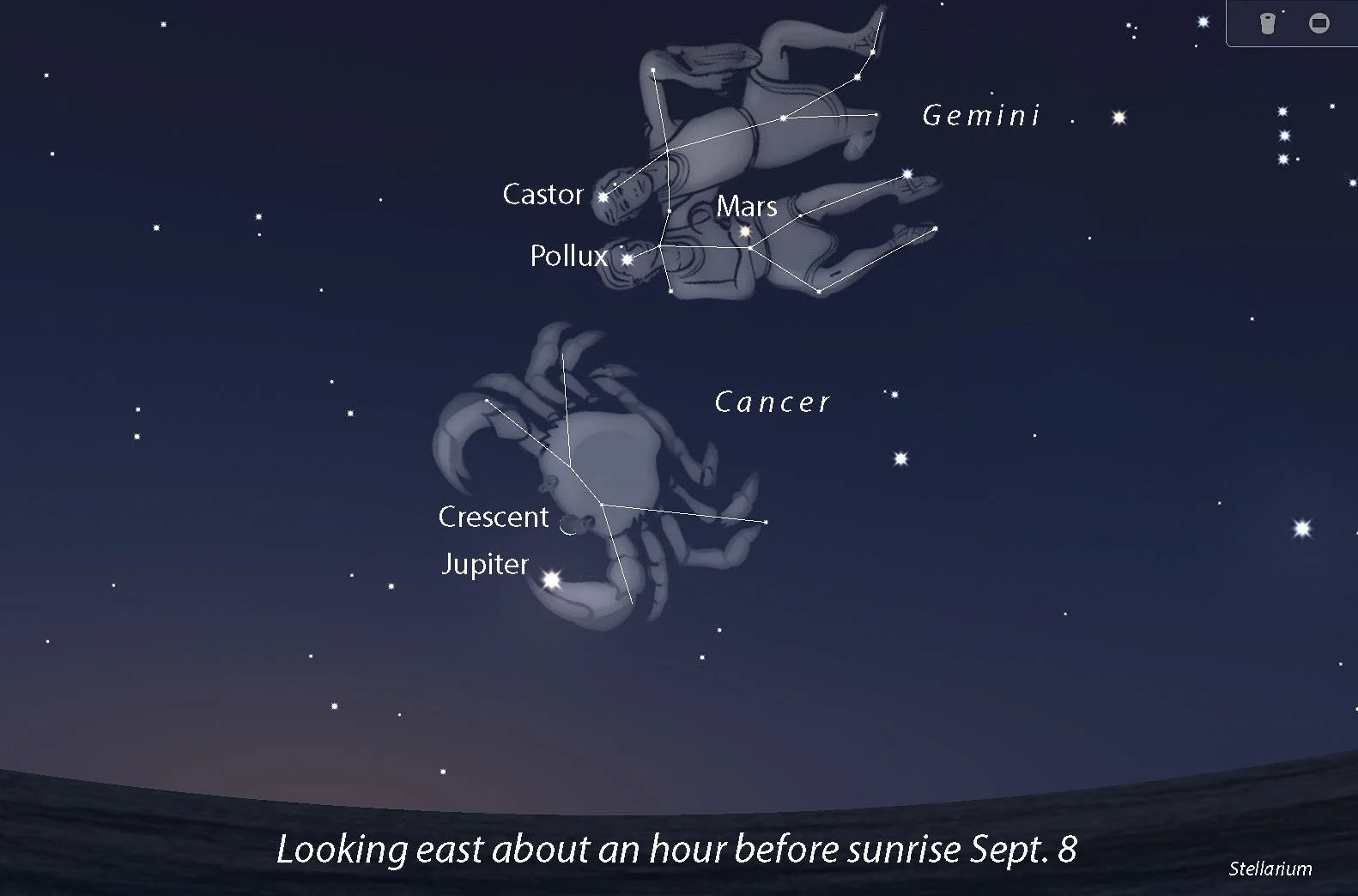
Sept. 8 (a.m.) – Very thin crescent pairs with brilliant Jupiter low in the northeastern sky in early dawn.

Sept. 9-23 – Zodiacal light visible as a large, tapered, milky glow standing up from the eastern horizon in a dark sky just before the start of dawn. Similar in brightness to the Milky Way, it’s made of dust shed by comets and asteroids that gathers in the plane of the solar system. Sunlight sets it aglow.
Sept. 10 – New moon. Moon near the sun in the daytime sky and not visible.
Sept. 14 – Thin, waxing moon shines to the left of Venus very low in the southwestern sky in early dusk. Look about 20 minutes after sunset.
Sept. 18 – First quarter moon shines low in the south at sunset.
Sept. 22 – Autumnal equinox. Fall begins at at 7:05 p.m. Day and night are approximately equal across the planet – 12 hours of daylight and 12 hours of night.
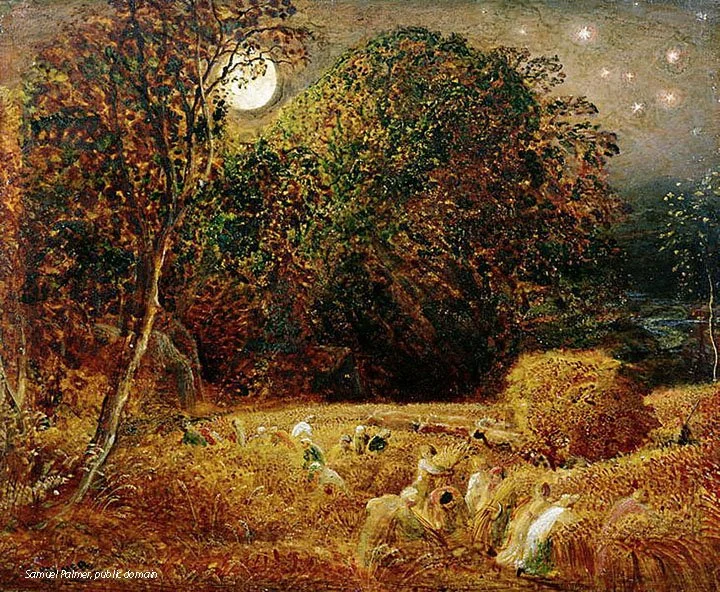
Sept. 26 – Full Harvest Moon. For several nights centered on this date, successive moonrises are only about 20 minutes apart. Go to https://www.timeanddate.com/moon/ to find your local moonrise time. It also shines above the planet Saturn tonight.
Sept. 26 – Neptune at opposition and closest to the Earth at 2.7 billion miles. Visible in 50mm binoculars from a moonless, semi-rural sky. It looks like a star but a telescope will show a tiny, blue disk. Neptune’s in the constellation Pisces the Fish not far from Saturn. Use the Stellarium app described above to track it down.
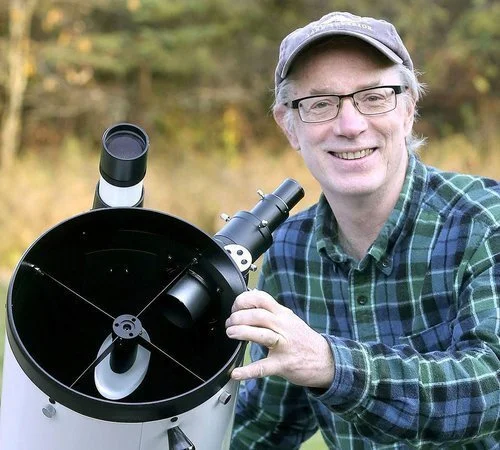
Bob King is an amateur astronomer, author, and passionate educator. He served as a photographer and photo editor at the Duluth News Tribune for 39 years and taught at the UMD planetarium. Bob’s work had a great impact on Voyageurs National Park. To achieve International Dark Sky Park certification, the park was required to host dark sky education events. Through the Night Sky Explorer webinars, the Conservancy was able to fulfill this component and help secure the certification for Voyageurs National Park. We can’t thank Bob King enough for sharing his talents and knowledge with the Conservancy community to support dark sky preservation.