
This article is authored by Julia Ponder, who has over two decades of experience with The Raptor Center at the University of Minnesota and is a member of the Voyageurs Conservancy board.
Dr. Bill Bowerman has led a team studying the eagles of Voyageurs National Park (VNP) for over 37 years. It has been my privilege to be part of this team in recent years and a highlight of each summer when we load the boats for our annual expedition to survey and band bald eagle chicks in the park. Last year, what we found was devastating – a dramatic decline in the number of successful nests and chicks, likely the result of a precipitous decline in breeding pairs. This year, despite a lack of research funding for the season, we headed out anyway with trepidation and curiosity at the request of national park staff. What would we find in the new breeding season?
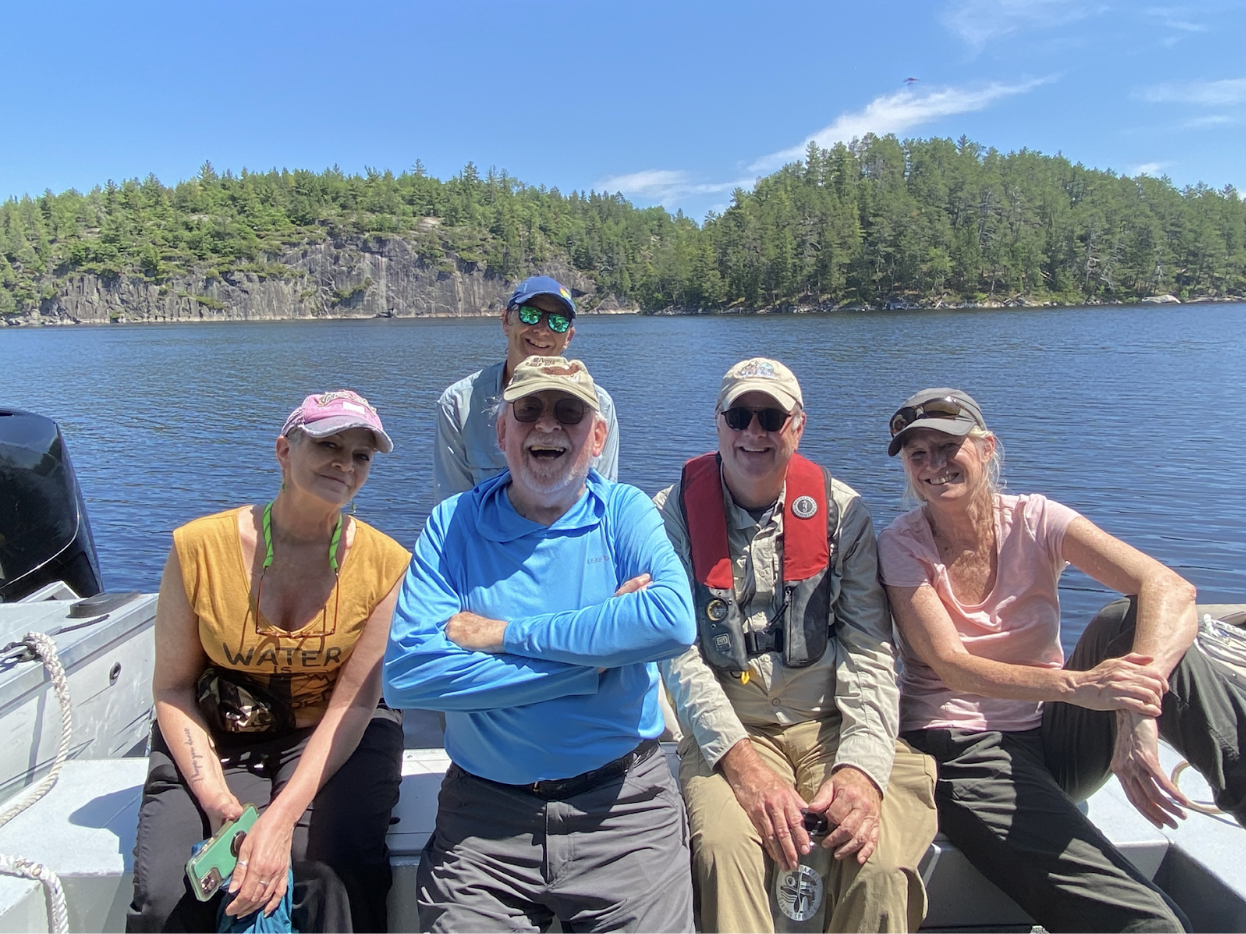
The 2025 Eagle Banding Team, including Julia Ponder (right)
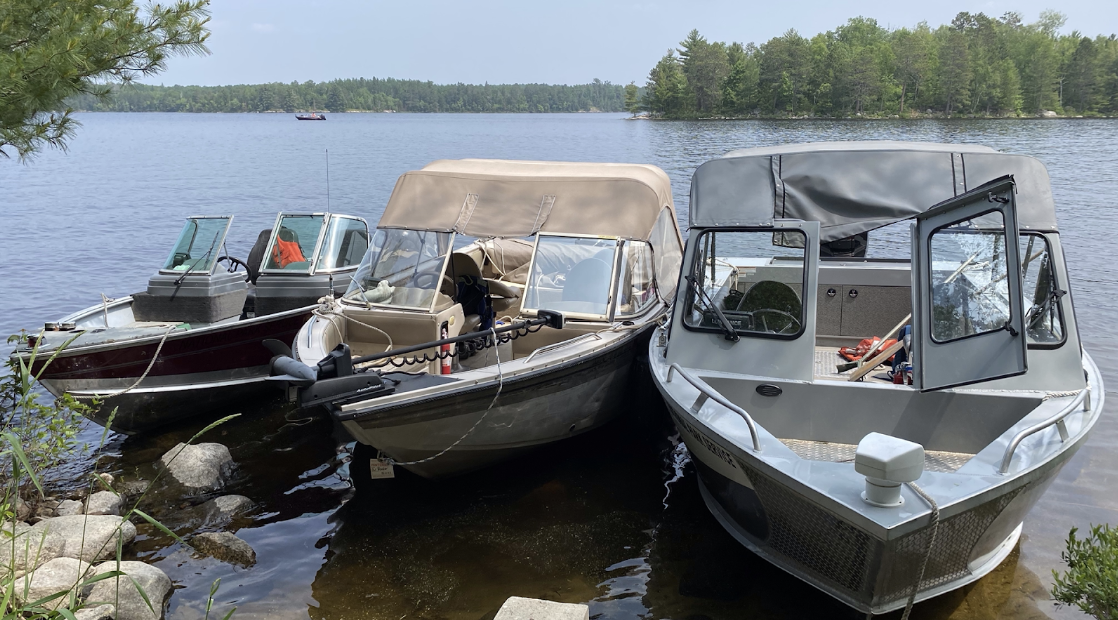
Boats tied up side-by-side at a field site
Highly pathogenic avian influenza, a disease that has devastated parts of the poultry industry in recent years, emerged in 2021 as a significant problem for wild bird populations, especially raptors such as the bald eagle. A dramatic population decline similar to what we observed anecdotally in Voyageurs National Park has been documented in northern Michigan since the arrival of avian influenza with nest occupancies dropping 40% or more. We estimated an even greater reduction at VNP with up to two-thirds of the breeding pairs gone. While we do not know how much the actual population numbers dropped, studies by organizations such as The Raptor Center at the University of Minnesota and the Michigan Department of Natural Resources demonstrated devastating impacts of avian influenza on eagles.
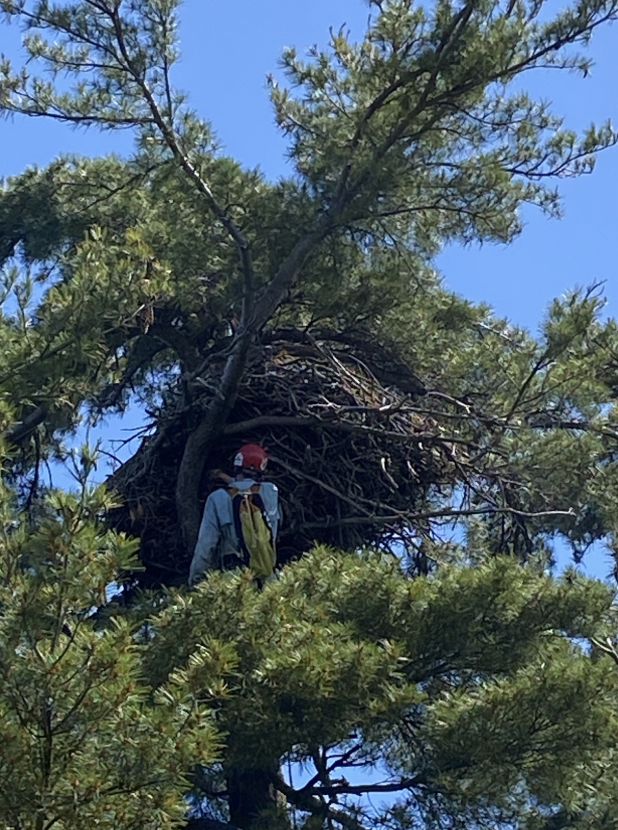
Climbing to an eagle nest
Each year during our field work, we spend our first day in the Crane Lake/Sand Point Lake area, the second on Kabetogama and the final day on Rainy Lake. We boat to active nests identified earlier in the season through surveillance trips with the purpose of assessing the season’s young eaglets, collecting data on reproduction, taking biological samples to study contaminant exposure and banding the chicks for future identification. While each team member has expertise and a role, our tree climber might be the most key person. Typically, eagle nests are found in the top third of the tallest white pine in the area. In addition to the tough climb, the nests can be huge and difficult to climb into as eagles add to them each year as part of their mating ritual, growing over time in both breadth and depth. A nest used for many seasons can weigh close to two tons. Once the nest is accessed, the tree climber collects the eaglets one at a time, placing them in a soft drawstring bag and lowering them to the rest of the team for sample and data collection. Fifteen minutes after reaching the ground crew, the eaglet is headed back up to the nest, no doubt a bit perplexed by what just happened. On a good day, the team can complete the work at five or six nests, with each nest having 1-2 eaglets.
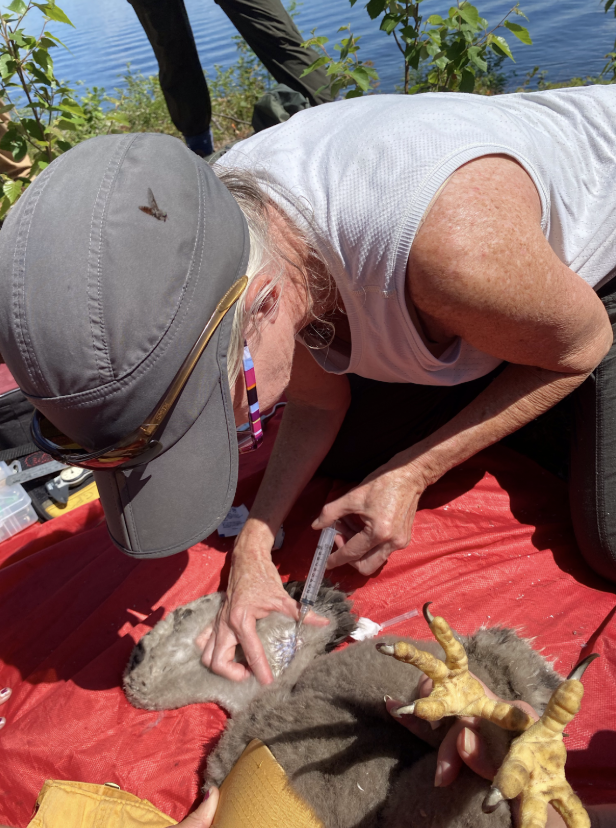
Taking a blood sample from an eaglet
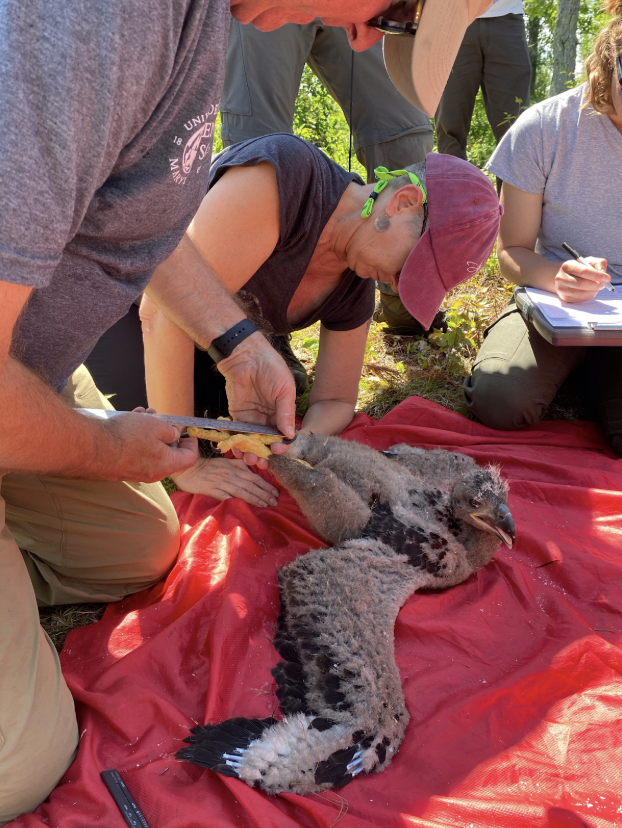
Taking foot measurements on a young eaglet
In 2024, we did not have a successful nest site on our route until the afternoon of our second day. Over three days, our results were abysmal – there was clearly a population level impact occurring and we could only assume avian influenza was the cause. As conservationists, our hearts hurt. As scientists, we looked ahead to this year’s season, wondering what we would find. Would this be a short-term impact or the beginning of something even more dramatic? The need to answer this question overrode a new challenge – lack of funding for the year’s research. Despite that barrier, the team gathered again from around the country, this time as all volunteers, to find some answers.
I am happy to share that the 2025 survey news was generally good. While not a banner year for numbers, we found successful nests beginning on our first day. Nests were surveyed, chicks were measured and banded and samples were collected to continue on-going studies on contaminants such as heavy metals, PCBs and PFAS. In addition, we found indicators of young breeders. Usually, bald eagles begin breeding at age five or six. In nature, when there is a lack of mature individuals, breeding will often begin at a younger age. Based on molted feathers we found, we could identify younger breeders. While perhaps a sign that we lost a large number of mature adults in recent years, it is also an indicator of nature’s resilience.
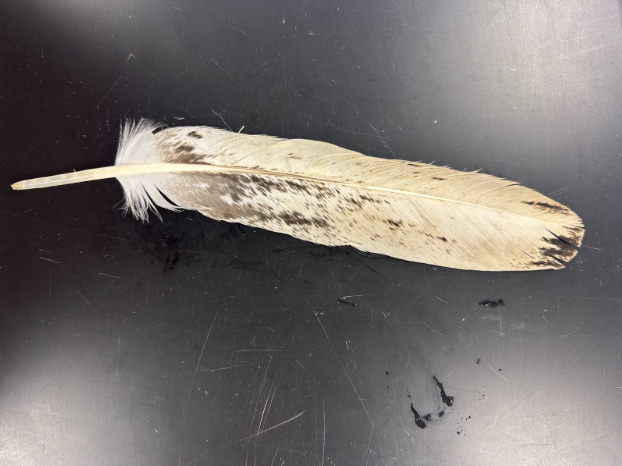
An immature (4 year old) eagle tail feather found at nest site
While it is often assumed that we know a lot about wildlife populations, reality is that without this type of long-term study, we would not have seen any of this. We would not know how breeding seasons are shifting over time or the trends of contaminant exposure in eagle populations. Nor would we have data on how policy changes such as the DDT ban and lake level management changes, impact wildlife populations.
While we cherish Voyageur National Park for its beauty and its wildlife, we also know there is so much to learn from it and our other national parks. We are truly grateful for our wonderful relationship with the National Park Service, Minnesota DNR, U.S. Fish and Wildlife Service, U.S. Forest Service, The Raptor Center, Utah State University, and the University of Maryland.
– Julia Ponder, DVM MPH; Voyageurs Conservancy Board Member
