
October 2025 Night Sky Explorer by Bob King
This month’s sky features two comets, three bright planets and a meteor shower. Saturn is easy to spot in the southeastern sky below the giant Square of Pegasus asterism as soon as it gets dark. Jupiter in Gemini is primarily a morning planet but nudging toward the evening hours. On October 1 it rises in the northeastern sky around midnight local time. By month’s end the brilliant gas giant rises around 10:30 p.m.
Venus is also still with us but dropping lower as the month progresses. Watch for this most radiant planet low in the eastern sky in Leo and then Virgo between 5:30 and 6:30 a.m.
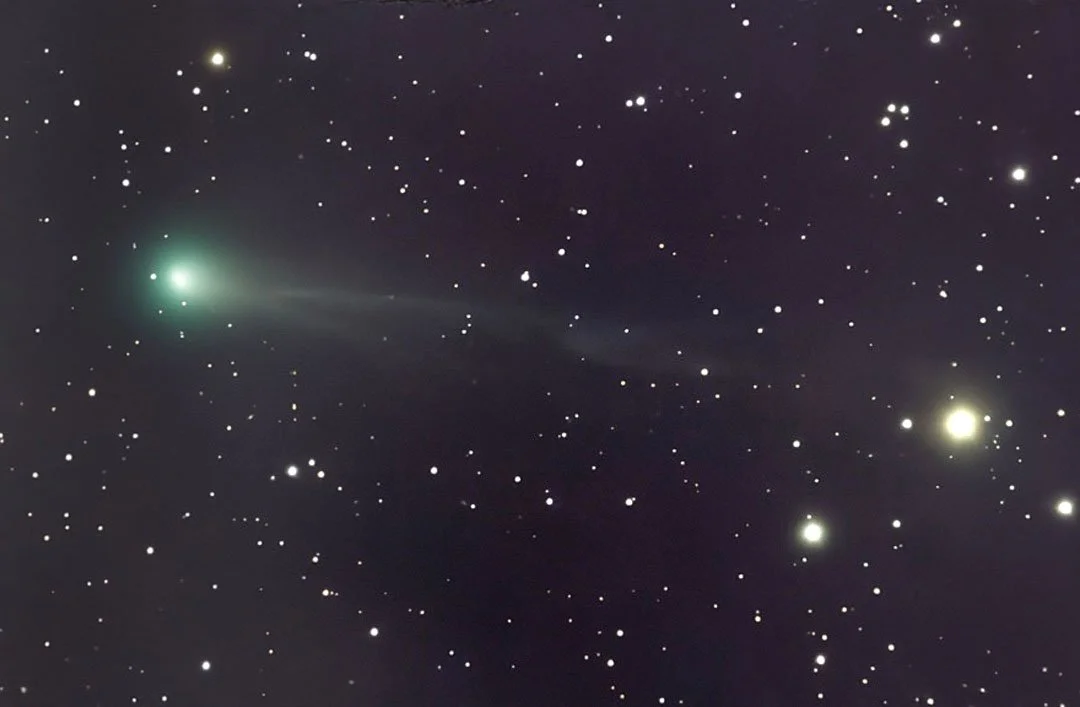
Two binocular comets — Comet Lemmon (named for the Mt. Lemmon sky survey in Arizona) and Comet SWAN — grace the skies. The former will likely be bright enough to see as a small fuzzball with the naked eye from country skies around mid-month. Comet SWAN, named for the Solar Wind ANisotropies instrument on the orbiting Solar and Heliospheric Observatory, may become faintly visible without optical aid. Most of us will need a map and binoculars to see it.
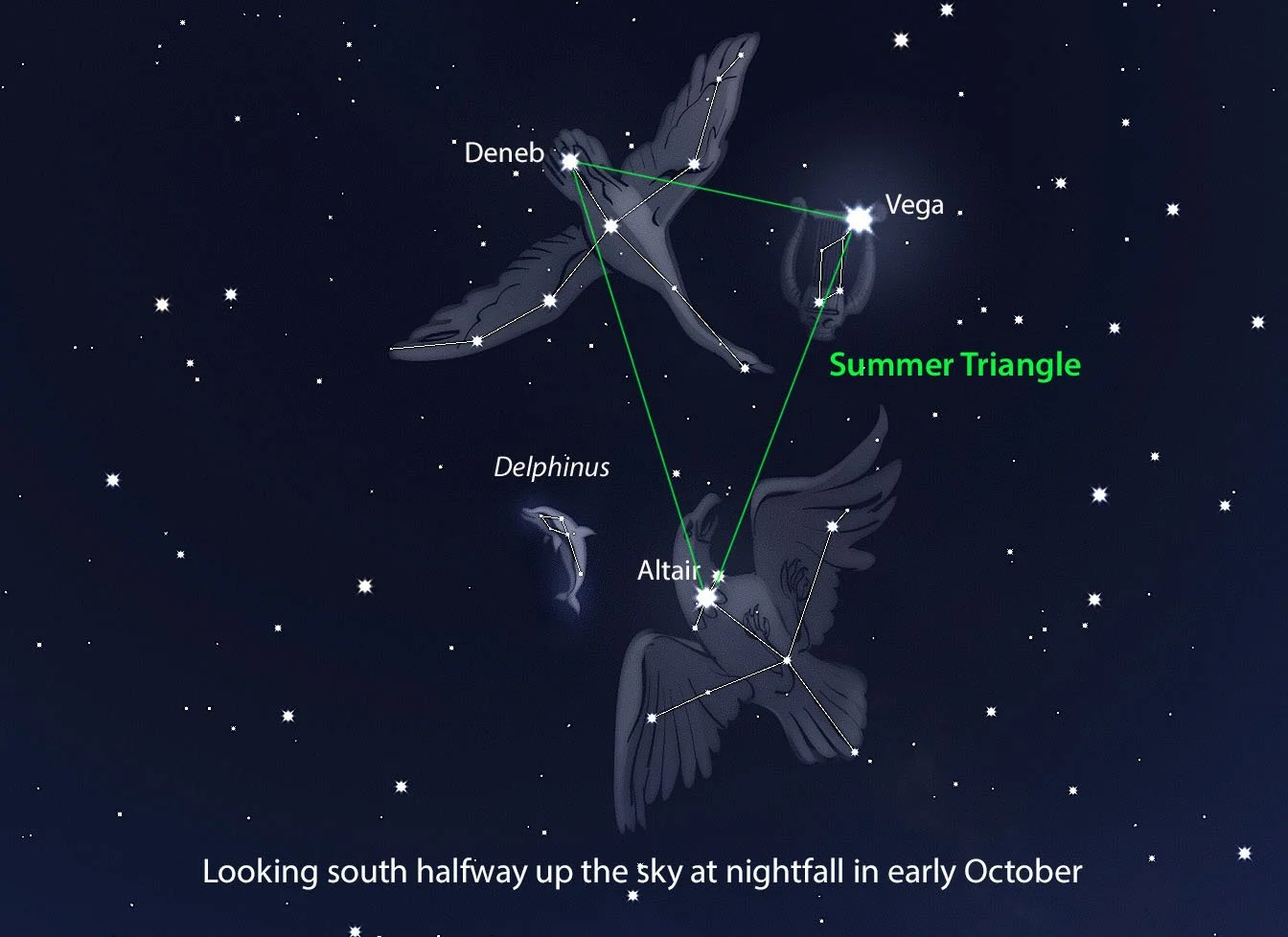
Our featured constellation is Delphinus the Dolphin, a small group of stars that resembles a kite. In terms of size, the dolphin ranks 69 out of 88, the total number of constellations. It’s easy to find — just a little more than one outstretched fist to the upper left of Altair, the bright star at the bottom of the Summer Triangle asterism. Although it has no particularly bright stars, the dolphin’s distinctive shape and compact form make it very easy to spot.
As with many of the familiar constellations, Delphinus derives from ancient myth. Poseidon, the Greek god of the sea, sought a wife among the Nereids or sea nymphs. He had his eyes on Amphitrite, who wanted nothing to do with him. Undeterred, the watery god sent a dolphin to woo her. It worked. They married, and as a gesture of appreciation for his service, Poseidon placed the dolphin in the heavens where he still resides in the 21st century.
Download the free Stellarium Mobile app for Android and iPhone to help you find and identify the current planets and constellations. Do a Google search, then install the app, set it in night mode (red screen) and point your phone skyward. For a free October sky map and calendar go to www.skymaps.com/downloads.html I also update on auroras and other sky events on Facebook at https://www.facebook.com/astrobobking/
Events (a.m. indicates the event happens in the morning sky):
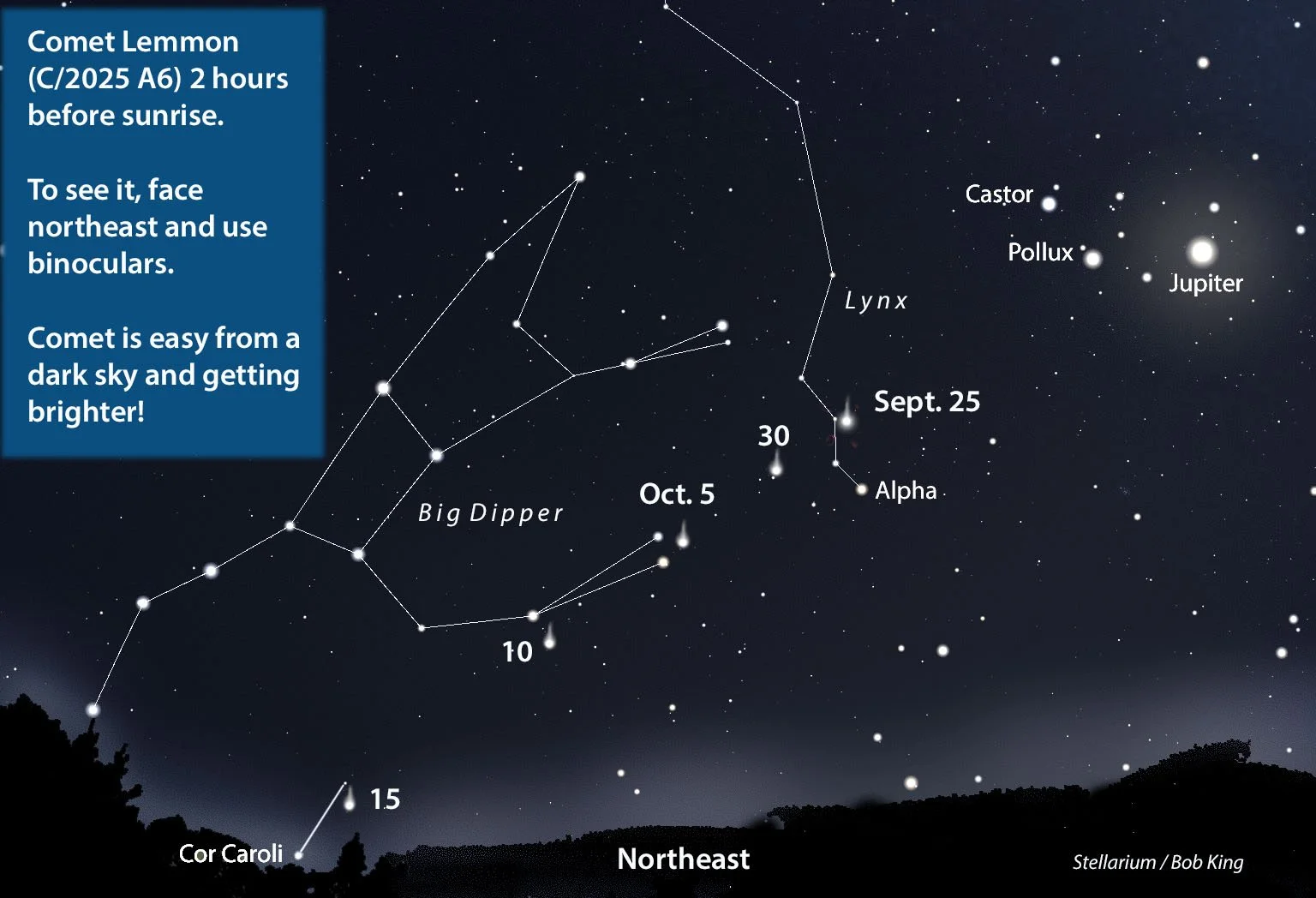
Oct. 1-15 (a.m.) – Best morning view of Comet Lemmon as it cruises beneath the Bowl of the Big Dipper. Look shortly before the start of dawn with binoculars in the northeastern sky.
Oct. 5 – Nearly full moon shines atop Saturn
Oct. 6 – Full Harvest Moon. Rises around local sunset and sets the next morning around sunrise. For several nights around full moon, the time delay between successive moonrises will only be about 20 minutes. This is the “Harvest Moon Effect” and caused by the moon’s path being nearly parallel to the eastern horizon. Instead of sinking deep below the horizon night after night, it dips only a short distance, shortening the delay between rising times. In olden times, it meant that a bright moon was available to light the way to continue harvesting into the evening hours.
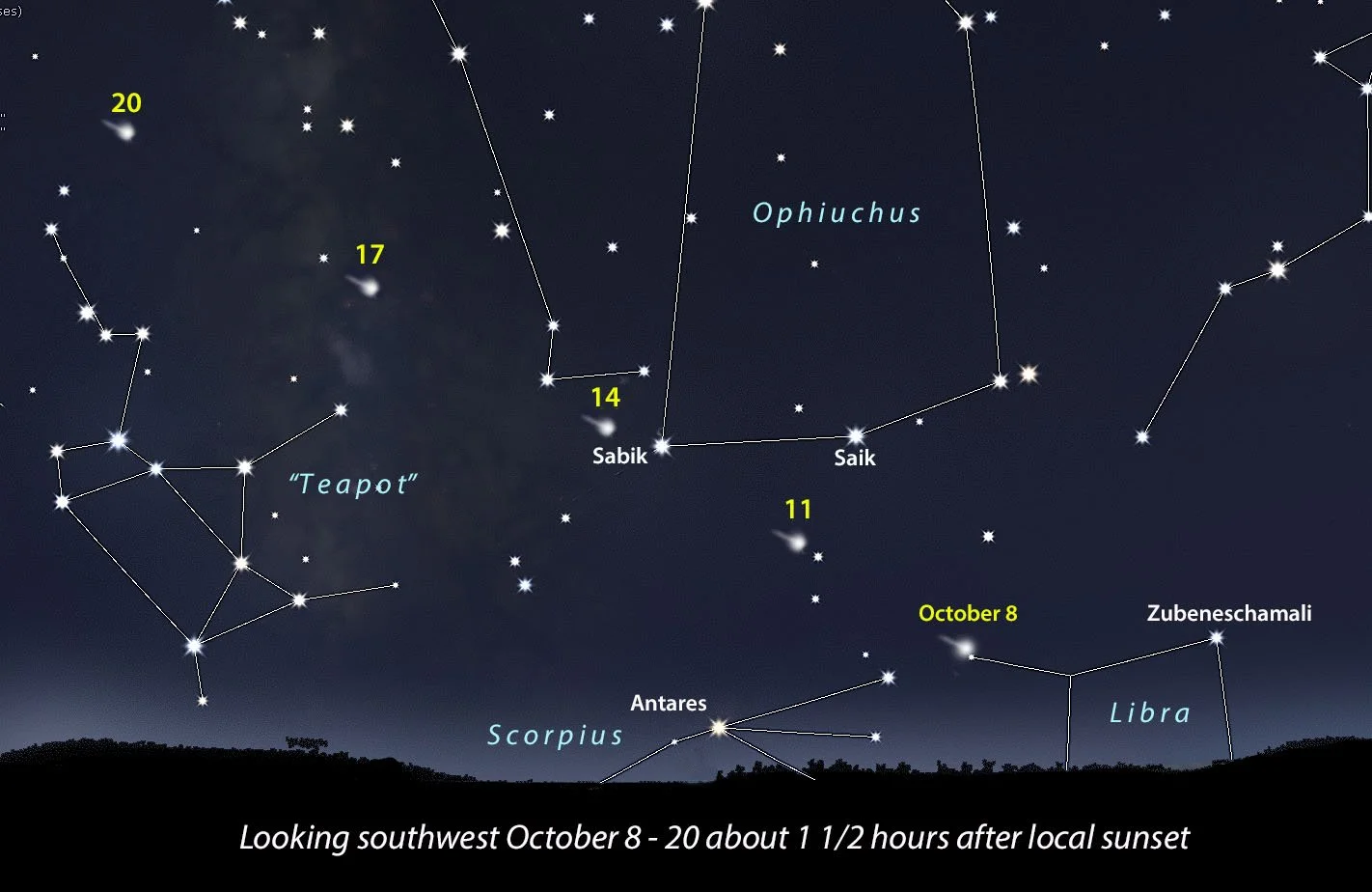
Oct. 8-20 – Best evening viewing of Comet SWAN (yes, yet another bright comet!) in binoculars and small telescopes as it travels low across the southwestern and southern sky at nightfall. Consult the map to know where to spot it.
Oct. 9 – Waning gibbous moon covers several of the Pleiades stars. Best view in binoculars and small telescopes. The event occurs between about 10:30 p.m. and midnight for the Upper Midwest. Times vary elsewhere.
Oct. 13 (a.m.) – Last quarter moon. The half-moon stands due south around the time of sunrise. Moon will be near the bright planet Jupiter in Gemini the Twins.
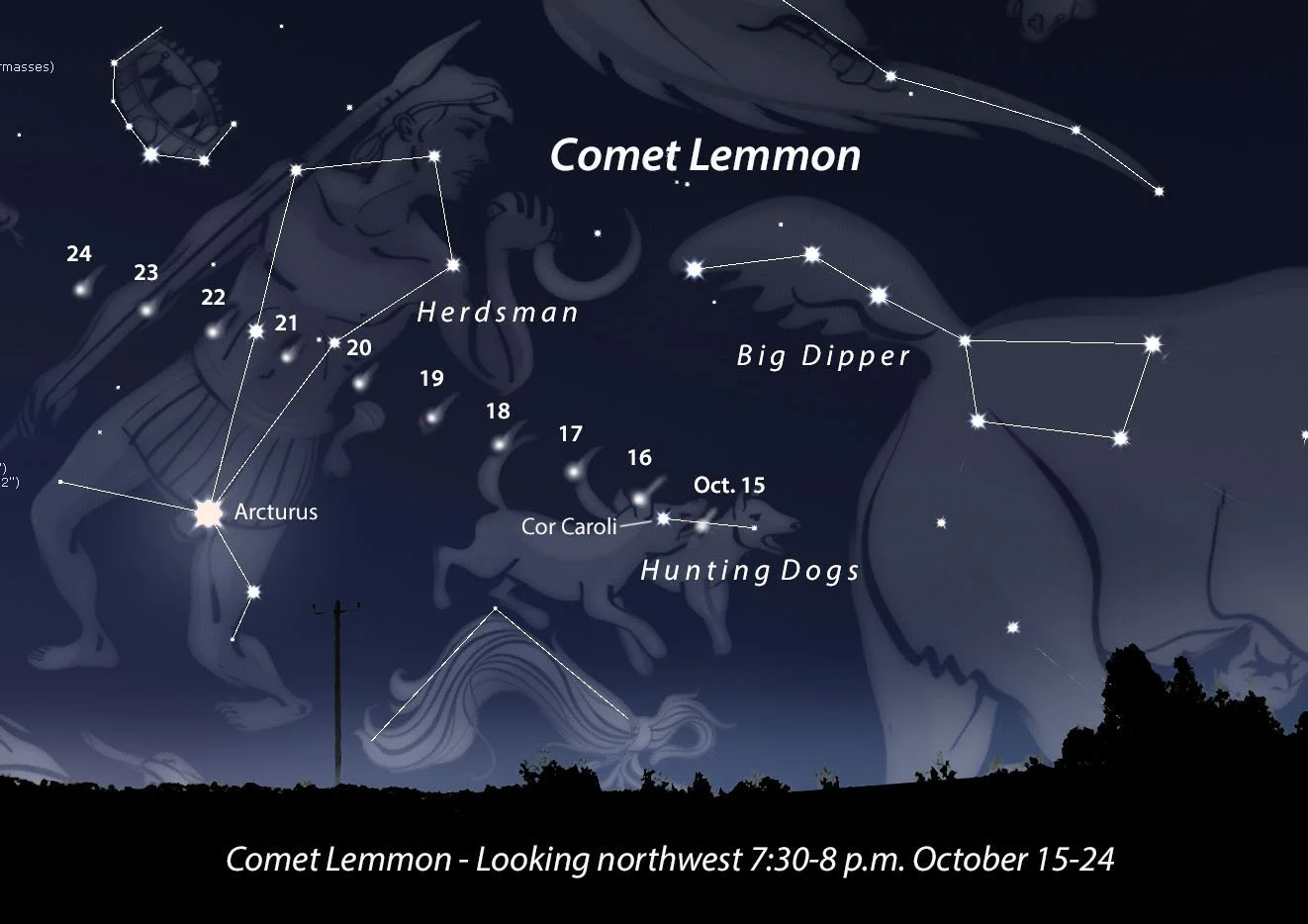
Oct. 15-31 – Comet Lemmon moves into the evening sky as it travels from below the Big Dipper’s Handle across the Herdsman constellation not far from Arcturus. It should be bright enough to see without optical aid from a rural sky and a fine sight in binoculars. I’ll post a fresh map and more information at www.facebook.com/astrobobking as the time approaches.
Oct. 15-30 – The International Space Station arcs across the twilight morning sky. For a complete list of flyovers for your city, log in to Heavens-Above.com, select your location and then click the blue ISS link. Or download and install NASA’s Spot the Station app at the app store or Google Play.
Oct. 19 (a.m.) – Thin, waning crescent moon forms a beautiful pair with Venus low in the eastern sky at dawn.
Oct. 19-31 (a.m.) – Watch for the soft, Milky Way-like glow of the zodiacal light extending upward from the eastern horizon between 2 hours and 90 minutes before sunrise. Shaped like a cone, it’s wider near the horizon and gradually tapers the higher up you look. The glow comes from dust spread across the plane of the solar system by comets, colliding asteroids and Martian dust storms. Sunlight faintly illuminates the material while the sky is still dark near the start of dawn. Venus is currently located near the base of the cone and Jupiter near its tip, so they make good guides.
Oct. 21 (a.m.) – Orionid meteor shower peaks between 1 a.m. and start of dawn local time. Perfect conditions with no moon to mar the show. Meteors will flare at the rate of about 15 per hour from a streaming point to the upper left of the bright, red-orange star Betelgeuse in Orion.
Oct. 21 – New Moon. The moon lies in the same direction as the sun and is invisible in the daytime sky.
Oct. 27 – Thick, waxing crescent will pass below and almost touch the star Tau Sagittarii during evening twilight for skywatchers in the eastern half of the U.S. From some locations it will cover the star. Use binoculars. For a list of cities and times when the star disappears and reappears go to http://www.lunar-occultations.com/iota/bstar/1027zc2784.htm. Times shown at the site are in Universal Time. Subtract 4 hours for Eastern, 5 for Central, 6 for Mountain and 7 for Pacific.
Oct. 29 – First quarter moon. In this phase, the half-moon stands high in the southern sky at sunset.
Visit my Astro Bob page on Facebook at www.facebook.com/astrobobking for updated astronomy news, aurora forecasts and the latest comet maps.
Clear skies! --- Bob

Bob King is an amateur astronomer, author, and passionate educator. He served as a photographer and photo editor at the Duluth News Tribune for 39 years and taught at the UMD planetarium. Bob’s work had a great impact on Voyageurs National Park. To achieve International Dark Sky Park certification, the park was required to host dark sky education events. Through the Night Sky Explorer webinars, the Conservancy was able to fulfill this component and help secure the certification for Voyageurs National Park. We can’t thank Bob King enough for sharing his talents and knowledge with the Conservancy community to support dark sky preservation.
