
By Bob King
Orion and friends, along with Jupiter and Mars, continue to command the southern sky. In the northeast, the Big Dipper stands on its handle, climbing higher and higher during the night. Look west in late twilight in early February, and you’ll still see Venus and Saturn holding their own. Sad to say, Saturn is slipping away and will soon disappear in the sunset glow. Come mid-month you’ll need binoculars to catch it, and by month’s end it’s out of the picture.
Venus also sinks closer to the sun as the month rolls on. On Feb. 1 it sets about 4 hours after sunset and just under 3 hours by month’s end. Venus is moving between Earth and the sun and exhibits a crescent phase like a miniature moon. By mid-February the crescent will be large enough to see the shape in a pair of 7-10x binoculars. Do this when Venus first appears in twilight. If you wait till darkness the planet’s glare makes it hard to see.
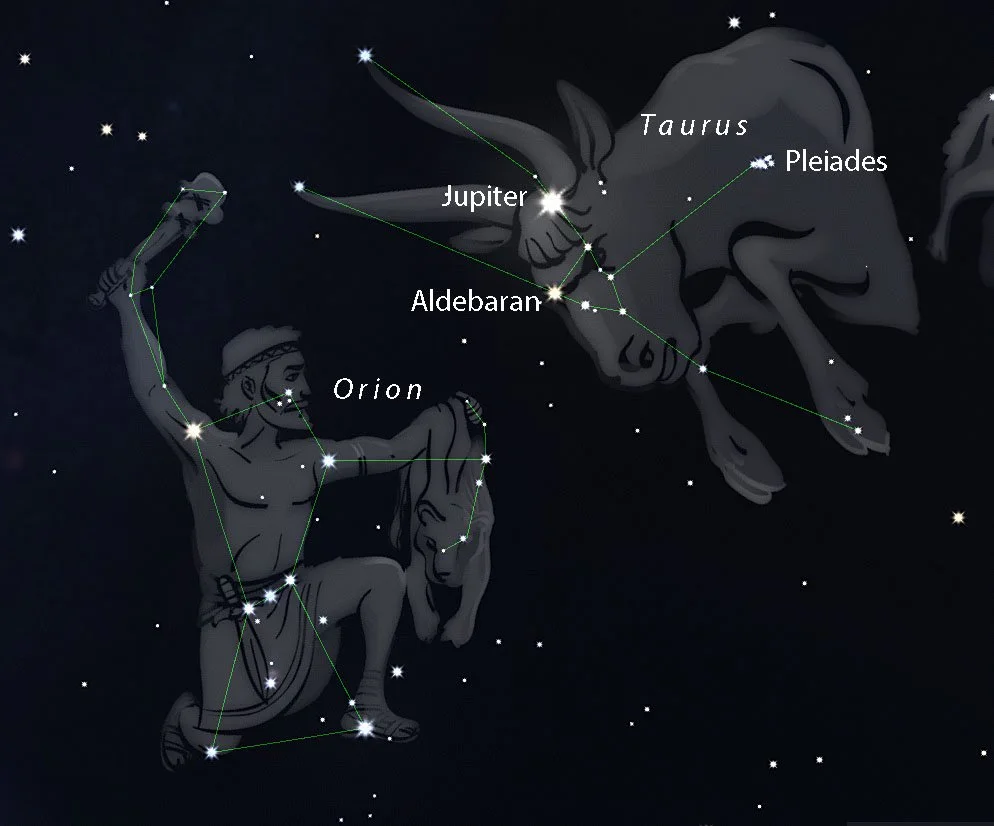
Our featured constellation, Taurus the bull, is one of the most ancient. Known in Babylonian times at the Bull of Heaven, the goddess Ishtar sent it to punish the demigod (and real king) Gilgamesh for not accepting her advances. Faced with an angry bull on a mission, Gilgamesh fought and slayed the animal. In Sumerian mythology, Gilgamesh is represented by Orion. We see their mythological battle in action every winter as Orion and Taurus face each other head on.
Download the free Stellarium Mobile app for Android and iPhone to help you find and identify the current planets and constellations. Do a Google search then install the app, set it in night mode (red screen) and point your phone skyward. For a free February sky map and calendar go to www.skymaps.com/downloads.html
February 2025 night sky happenings
Events (a.m. indicates the event happens in the morning sky):
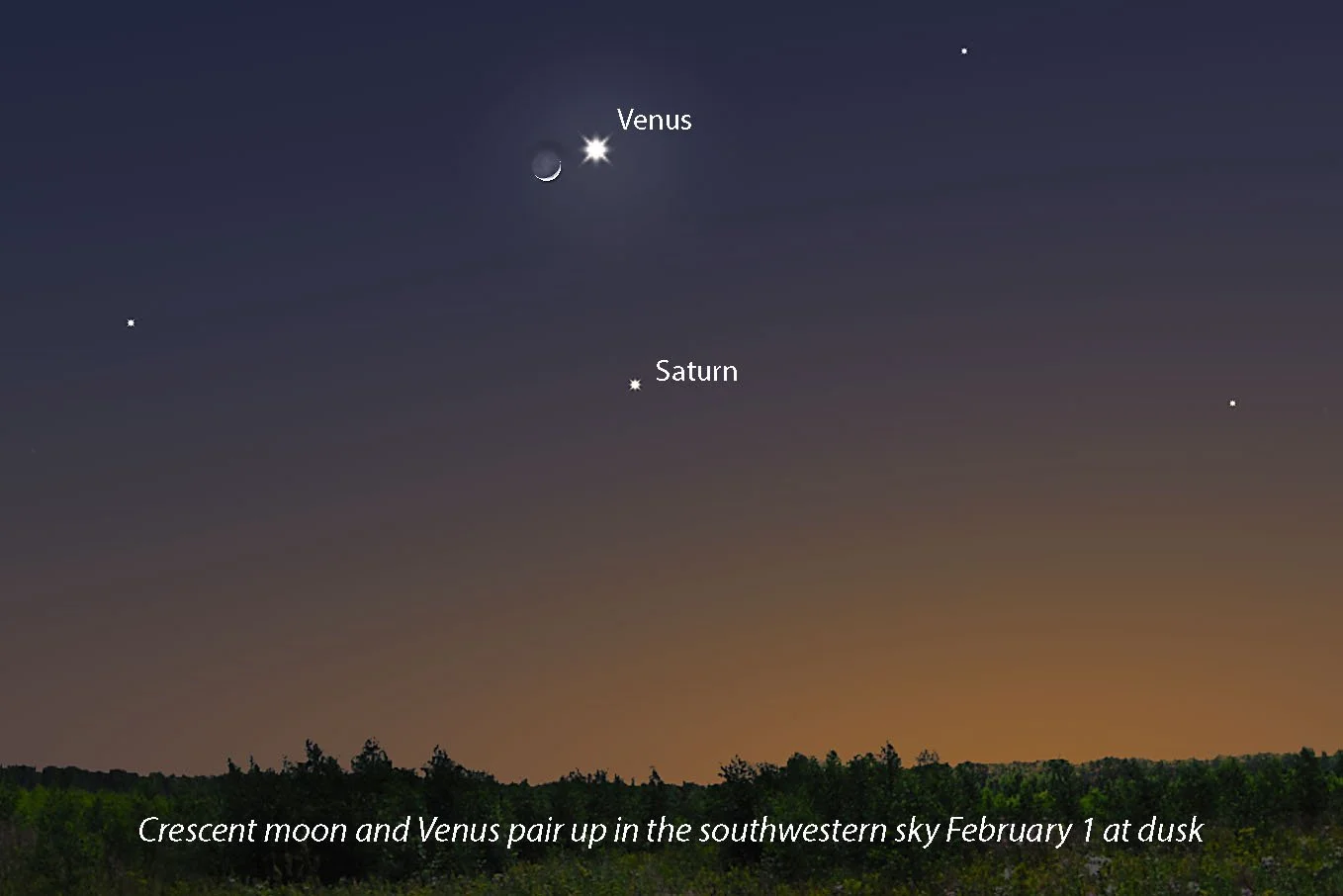
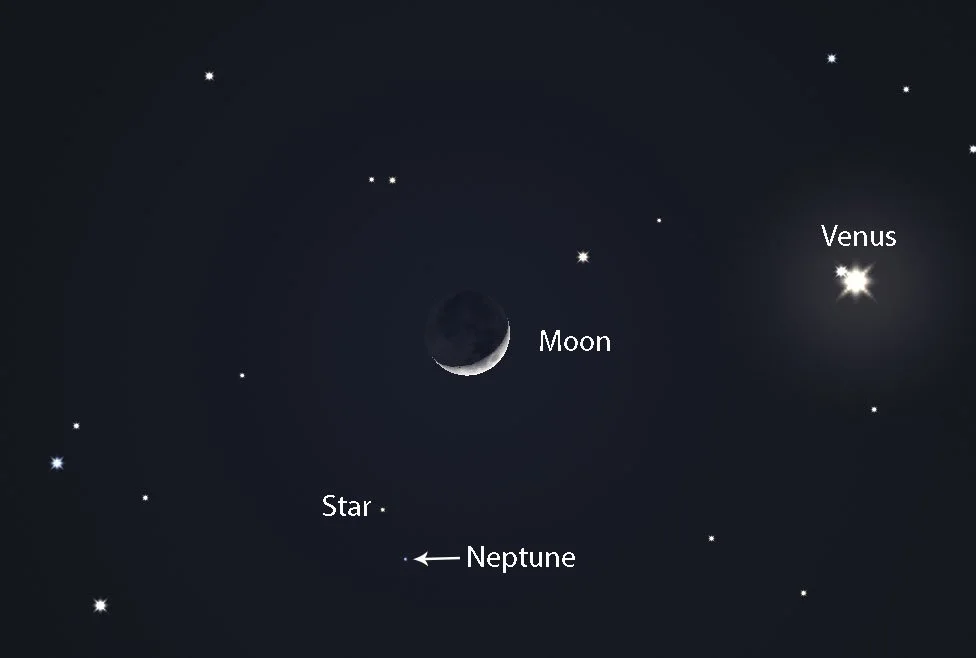
Feb. 1 – Face west during evening twilight to catch a beautiful conjunction of Venus and the young moon. They’ll be about 2 degrees (4 moon-diameters) apart. On the same night, the planet Neptune sits about 1 degree southwest of the moon. Use the map to spot it. The 8th and outermost planet will look like a faint star in binoculars and show a blue tint through a telescope.
Feb. 4 – First quarter moon
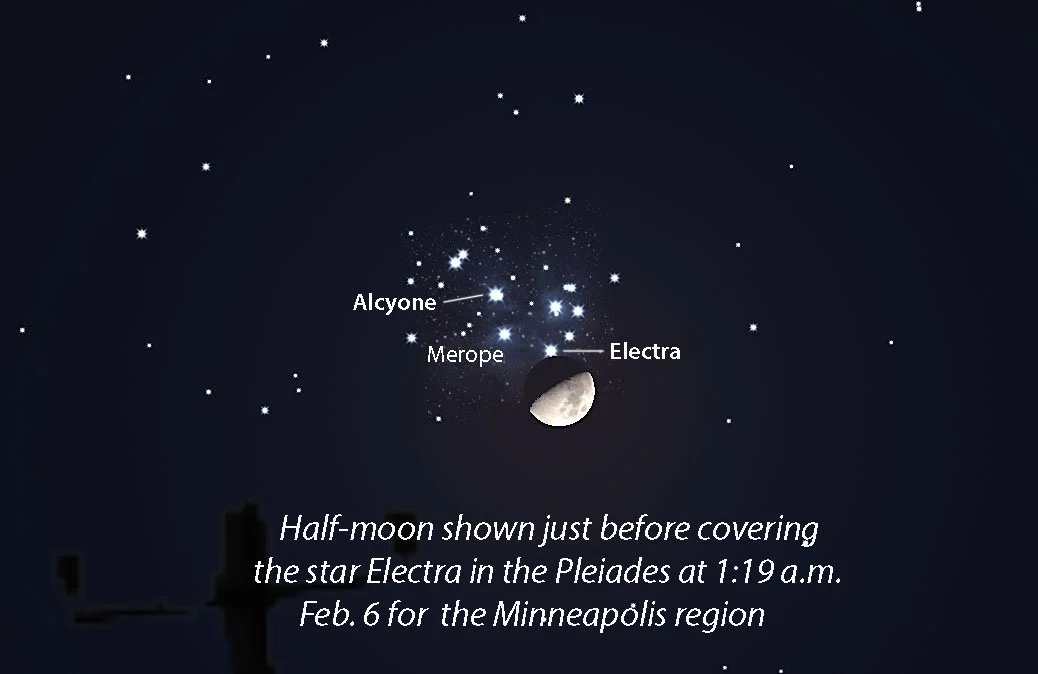
Feb. 5-6 (p.m., a.m.) – Waxing gibbous moon passes directly in front of the Pleiades star overnight on Feb. 5-6 and blocks (occults) several of its brightest stars for viewers in the western two-thirds of the U.S and Canada. Use 7-10x binoculars, or better, a small telescope to see through the moon’s glare. For the Minneapolis area the moon covers Electra around 1:19 a.m. CST; Merope at 1:48 a.m., and Alcyone (the brightest) at 2:15 a.m.
Feb. 6 – Brilliant Jupiter hangs below the bright moon
Feb. 9 – Waxing gibbous moon to the left (east) of Mars
Feb. 12 – Full Snow Moon shines in Leo the lion about 2 degrees to the left (east) of the bright star Regulus. Can you see it through the glare?
Feb. 15-28 (a.m.) – For the early risers, the International Space Station makes west-to-east passes in the dawn sky. For a complete list of pass times for your location, log in to Heavens-Above.com, select your location and then click the blue ISS link. Times are shown in local 24-hour time. For example, 18:50 is 6:50 p.m. Or just download NASA’s Spot the Station app at the app store or Google Play.
Feb. 17 (a.m.) – Waning gibbous moon in close conjunction with Spica, Virgo’s brightest star. It passes less than 1 degree (2 moon-diameters) below it during early morning twilight.
Feb. 20 (a.m.) – Last quarter moon
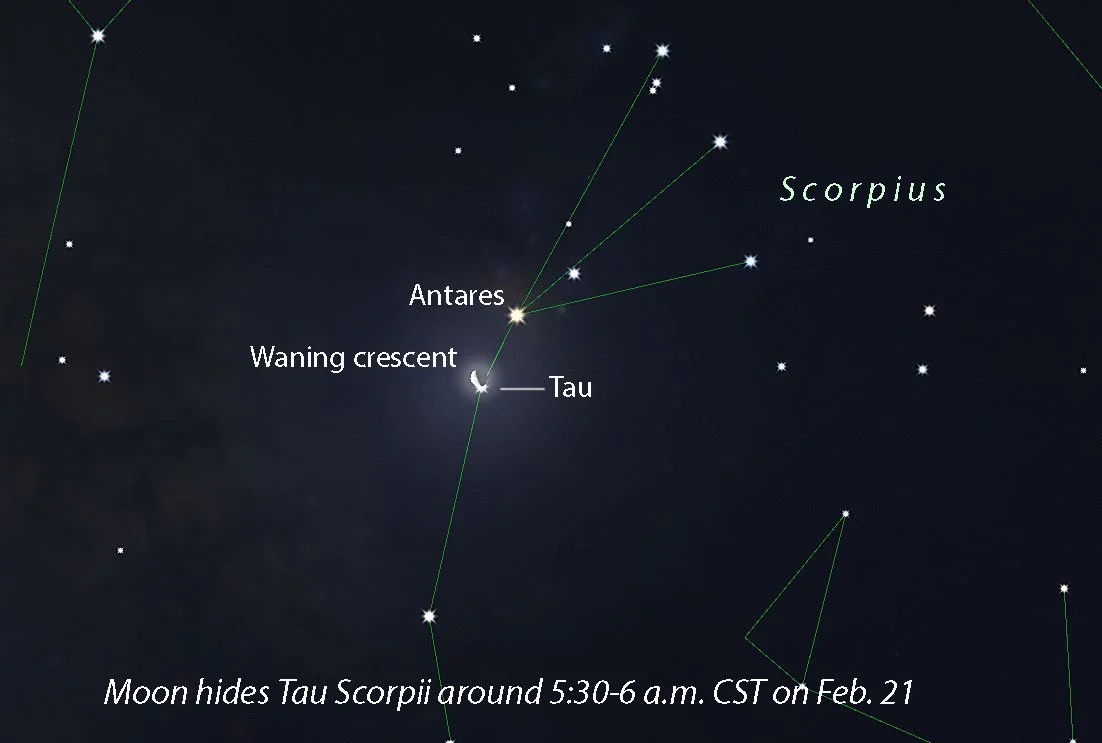
Feb. 21 (a.m.) – Waning moon occults the moderately-bright star Tau Scorpii just before dawn for the Midwest. In Minneapolis the star will skirt the moon’s bottom (southern) edge between about 5:36 and 5:52 a.m. local time. During that time, it will briefly pop out in and out of view. Farther north in Duluth, the star disappears at the bright southern edge at 5:32 a.m. and reappears along the dark edge at 6 a.m.
Feb. 18-28 – China’s Tiangong space station makes passes across the southern sky during the early evening hours. Like the International Space Station, it orbits the Earth with a crew of astronauts, but being smaller it looks fainter. For a complete list of pass times for your location, click the blue Tiangong link at Heavens-Above.
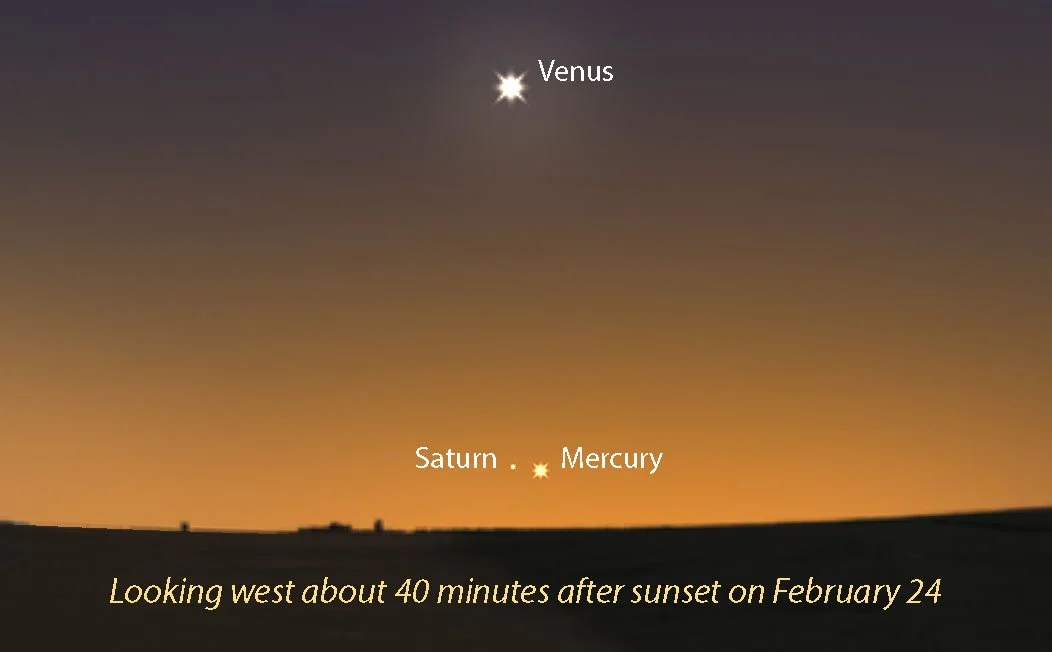
Feb. 24 – Mercury returns to the evening sky and joins Saturn in a close conjunction very low in the western sky about 40 minutes after sunset. The two will be about 1.5 degrees apart and only few degrees above the horizon. Mercury should be visible with the naked eye but seeing Saturn will take binoculars or a small telescope. Venus stands about two fists (20 degrees) above the pair.
Feb. 24 – Mars stops moving west in retrograde motion and resumes its normal or “direct” motion to the east.
Feb. 25-28 – Mercury climbs a little higher each night in the western sky as it leaves Saturn behind. Use binoculars.
Feb. 27 – New Moon

Bob King is an amateur astronomer, author, and passionate educator. He served as a photographer and photo editor at the Duluth News Tribune for 39 years and taught at the UMD planetarium. Bob’s work had a great impact on Voyageurs National Park. To achieve International Dark Sky Park certification, the park was required to host dark sky education events. Through the Night Sky Explorer webinars, the Conservancy was able to fulfill this component and help secure the certification for Voyageurs National Park. We can’t thank Bob King enough for sharing his talents and knowledge with the Conservancy community to support dark sky preservation.
