
By Brandon A. Guell, Ph.D.
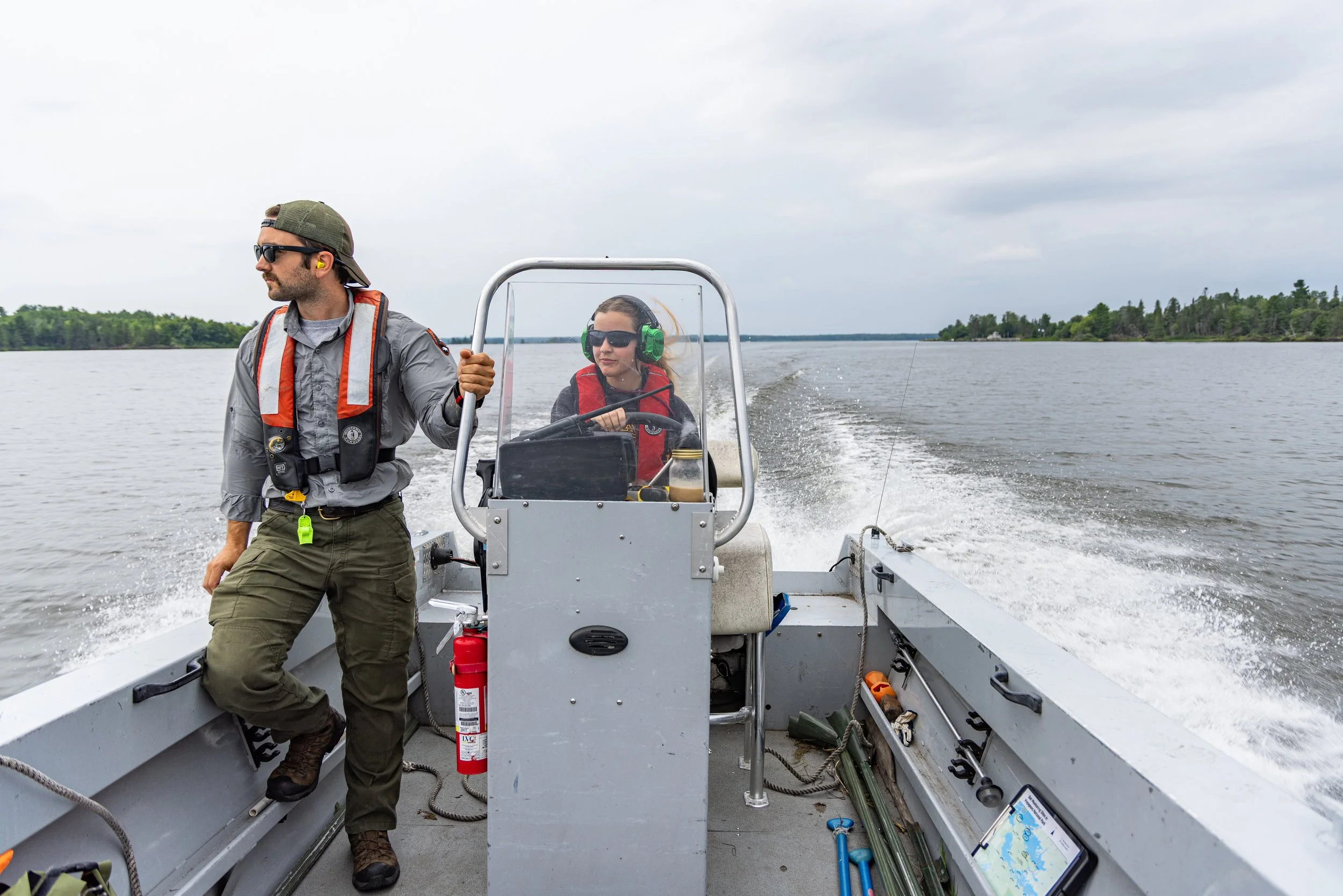
Voyageurs National Park Wildlife Technician Jacob C. Schiefelbein and Voyageurs Conservancy Field Fellow Mari Podas travel by boat to deploy acoustic bat monitors throughout the park. The monitoring effort takes researchers across Voyageurs’ lakes and into remote areas of the park.
Some wildlife research begins with looking for an animal. Other times, it begins by listening for one you may never see.
This summer, I joined Voyageurs National Park Wildlife Technician Ranger Jacob C. Schiefelbein and Voyageurs Conservancy Field Fellow Mari Podas for a day in the field deploying acoustic monitoring devices designed to record the ultrasonic calls of bats moving through the park after dark.
Getting those monitors into place is an adventure in itself. Voyageurs is a water-based park, so reaching remote monitoring sites can require several different forms of travel.
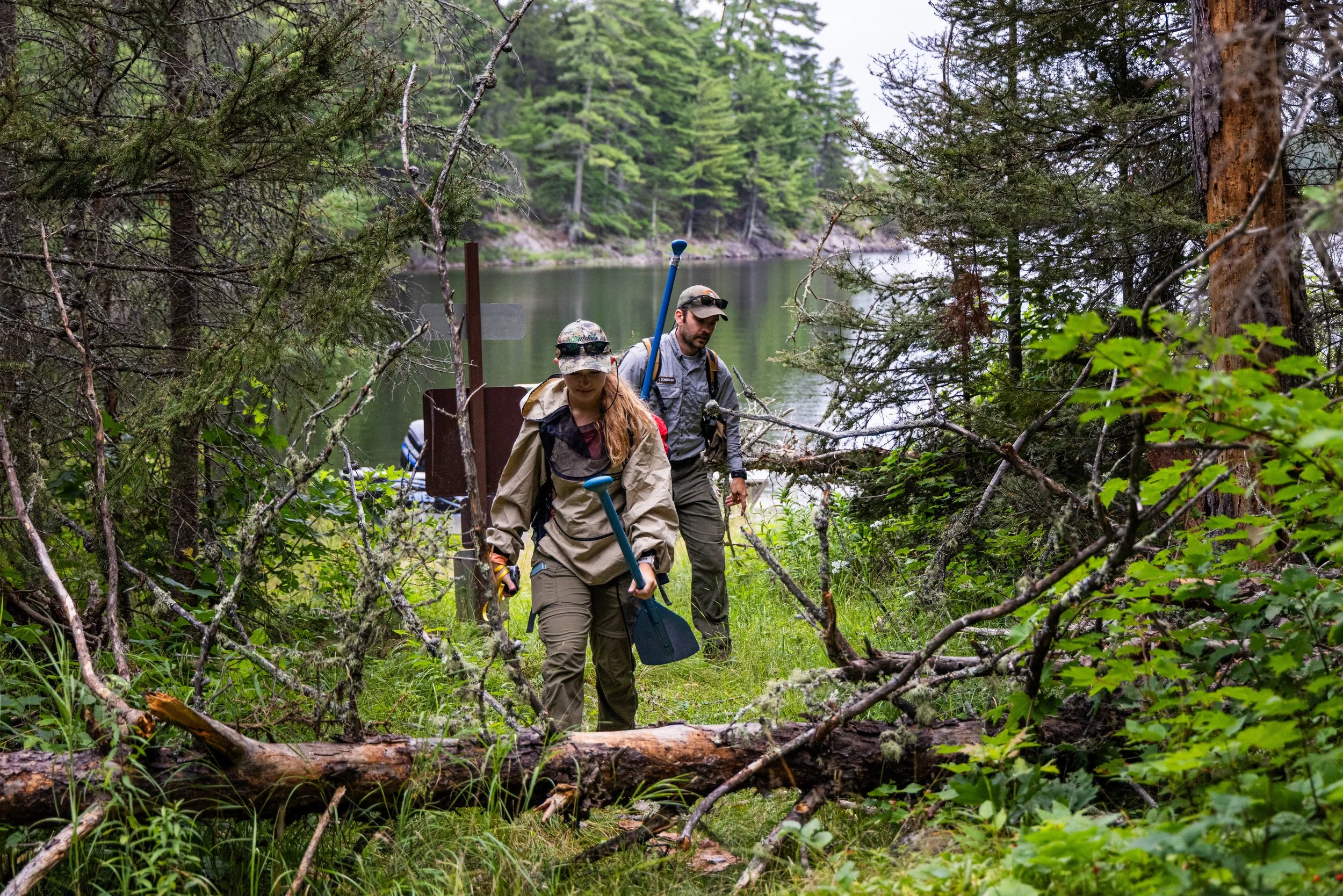
Reaching monitoring sites can require a combination of motorboat travel, paddling, and off-trail hiking. Here, Podas and Schiefelbein carry monitoring equipment from the shoreline into the forest.
We traveled by boat across the park, loaded our equipment into a canoe to reach more remote areas, and hiked off trail through the woods carrying acoustic devices, microphones, field notebooks, and other equipment. At each monitoring site, Jacob and Mari carefully found a previously selected location using GPS coordinates, set up the monitor and ultrasonic microphone, recorded field measurements and notes, and left the equipment behind.
Then, after we were gone and darkness settled over Voyageurs, the real work began.
Listening for Bats
Bats navigate and hunt largely through echolocation, producing high-frequency calls that are generally beyond the range of human hearing. Specialized acoustic devices allow wildlife researchers to listen to this otherwise invisible part of the nighttime landscape.
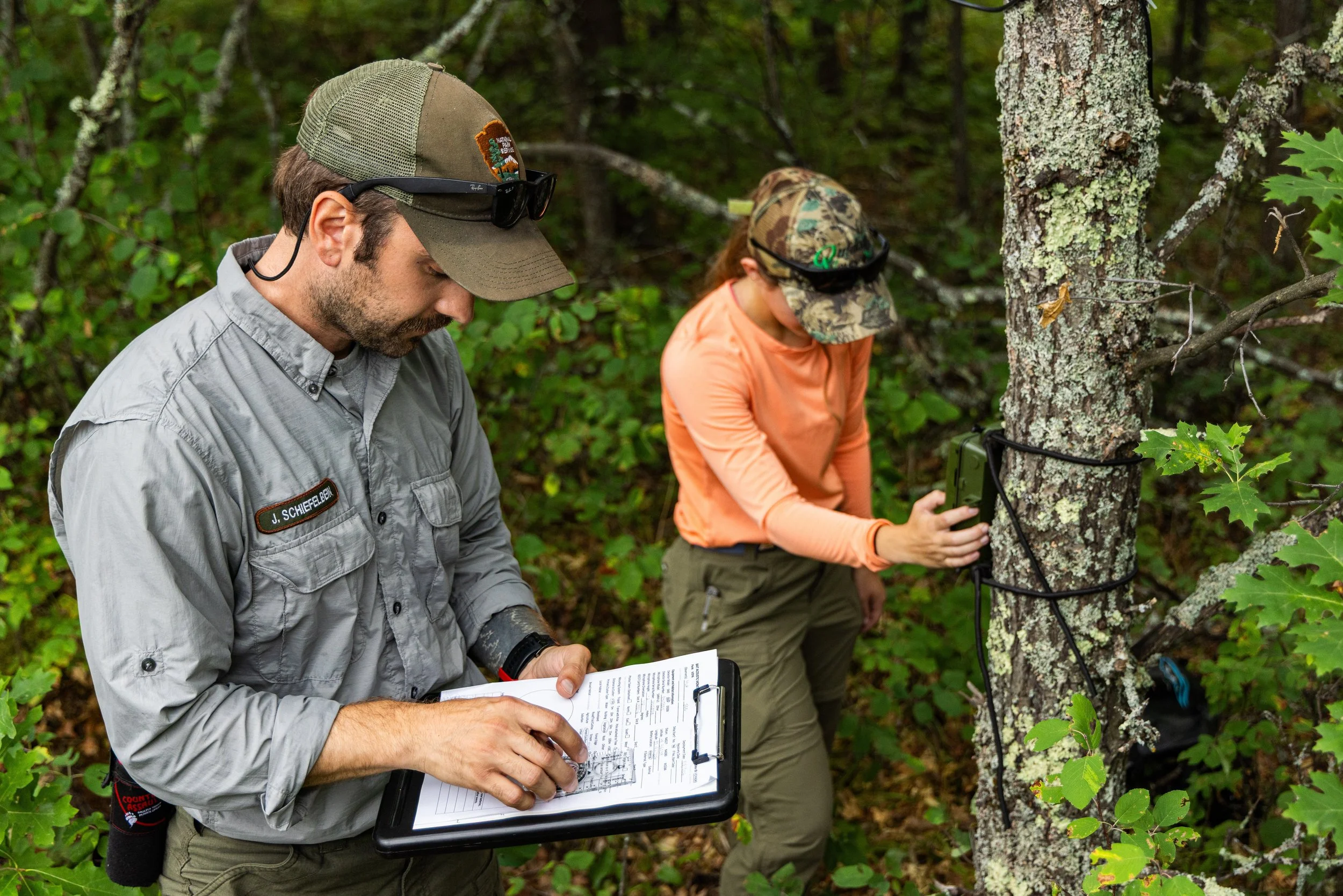
At each monitoring site, Schiefelbein and Podas install an acoustic device including an ultrasonic microphone and record standardized information about the site. Once deployed, the equipment records bat activity throughout the night.
Between June and mid-August, Voyageurs wildlife staff deploy acoustic monitors throughout the park. Each device remains at a monitoring location for approximately seven to fourteen nights, recording from 6:00 p.m. until 8:00 a.m.
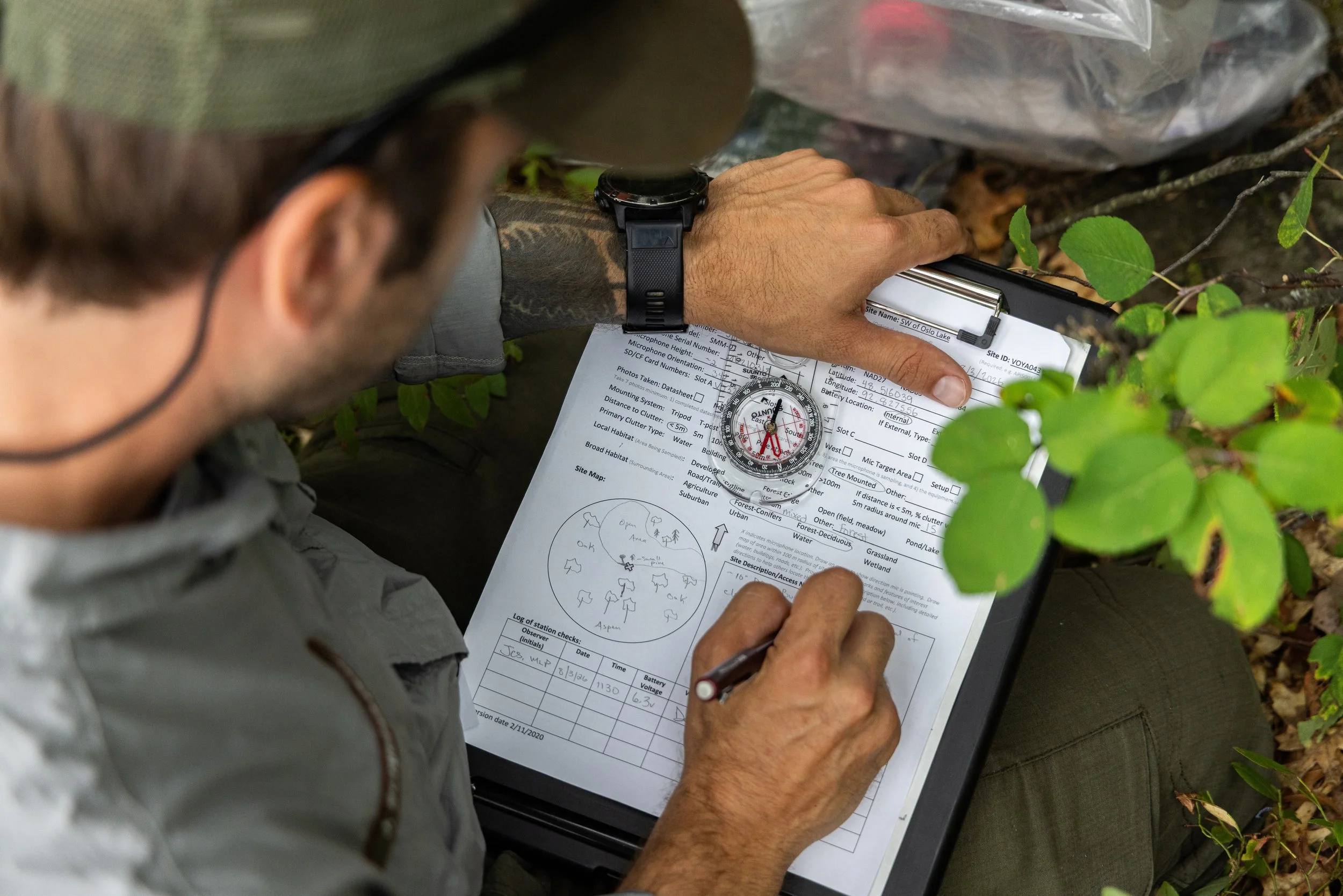
Careful field notes accompany every deployment, documenting the monitoring location, equipment setup, habitat characteristics, and other information researchers need to interpret and compare recordings through time.
Those recordings provide much more than evidence that a bat happened to fly past.
Specialized software analyzes the frequency and structure of each recorded echolocation call and helps researchers determine which species produced it. Researchers can also examine spectrograms—visual representations of sound—and identify bats based on characteristics such as the shape, frequency, and duration of their calls.
Together, those recordings help biologists assess the probable presence or absence of different bat species and their relative activity levels. Repeating the monitoring year after year provides something even more valuable: a window into how bat populations may be changing over time.
More Than a Decade of Monitoring
Voyageurs National Park has used its current acoustic monitoring protocol since 2015 as part of the National Park Service's Great Lakes Inventory and Monitoring Network. The park's data also contribute to efforts beyond Voyageurs, including the North American Bat Monitoring Program and U.S. Fish and Wildlife Service range information.
Several bat species are expected to occur within Voyageurs, including the silver-haired bat, little brown bat, northern long-eared bat, big brown bat, eastern red bat, hoary bat, and tricolored bat. For some of these species, understanding where they occur and how their activity changes through time has become especially important. The northern long-eared bat, for example, is federally endangered following catastrophic population declines driven primarily by white-nose syndrome. The U.S. Fish and Wildlife Service estimates the disease has caused declines of 97–100% in affected northern long-eared bat populations.
Another species expected at Voyageurs, the tricolored bat, is currently proposed for listing as endangered under the Endangered Species Act. Once considered common across much of its range, the species has also experienced dramatic declines from white-nose syndrome—estimated at more than 90% in affected colonies.
That gives long-term monitoring programs like this one significance beyond simply building a list of which bats occur in the park. Each season adds information about where species are being detected, how active they are, and whether those patterns are changing. For species facing major declines, those observations become part of a much larger body of scientific information that researchers and wildlife managers can use to understand their status and inform future conservation decisions.
What It Takes to Monitor a Wild Landscape
A small acoustic device attached to a tree might make bat monitoring look deceptively simple. Getting that device there—and building a reliable dataset year after year—is another story.
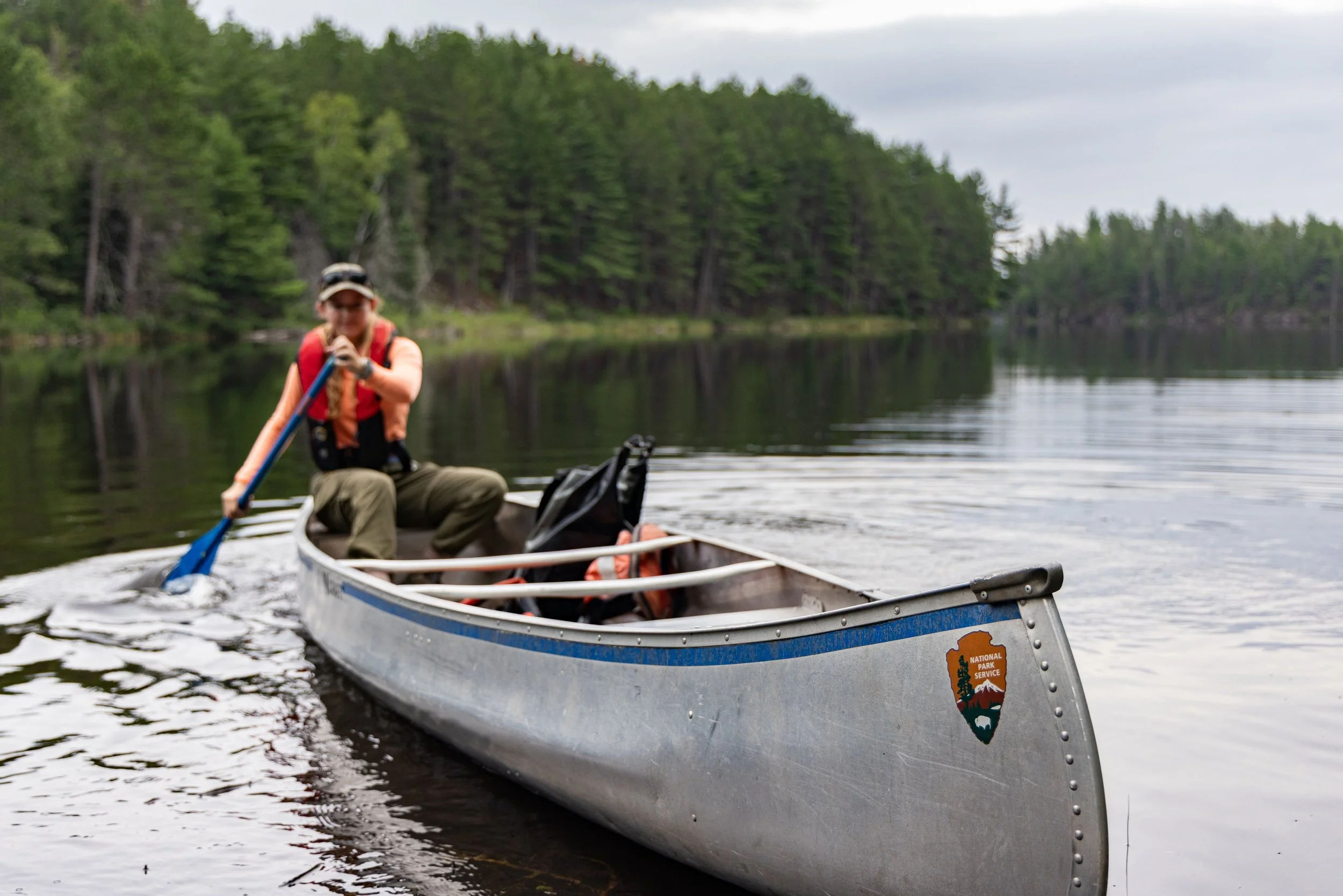
Some monitoring locations cannot be reached directly by motorboat. For remote backcountry sites, the field team may switch to a canoe before continuing into the forest on foot.
Voyageurs is a vast, water-dominated landscape, and many monitoring locations are far from a road or trailhead. Reaching them can mean loading equipment into a motorboat, crossing miles of open water, transferring everything into a canoe, paddling into a remote bay or wetland, and eventually continuing off trail through the forest with detectors, microphones, batteries, field notebooks, and other equipment.
And that effort isn't made just once. Equipment must be deployed and later retrieved, maintained, and moved among monitoring locations throughout the field season. At every site, staff follow standardized protocols, document conditions, position equipment correctly, and collect the information necessary to make recordings comparable across locations and years.
This is the less visible side of wildlife conservation. Behind a species detection on a map or a graph showing years of bat activity are people traveling across lakes, paddling into the backcountry, navigating through the forest, maintaining equipment, processing recordings, and returning to monitoring locations year after year.
The park's original monitoring locations were established using a randomized, spatially balanced sampling design. Eighteen sites have continued to be monitored each year, providing consistent locations researchers can compare through time.
In 2025, wildlife staff added nine additional monitoring locations outside those original sampling cells. These newer sites allow researchers to begin comparing bat activity between more accessible front-country locations and remote backcountry areas.
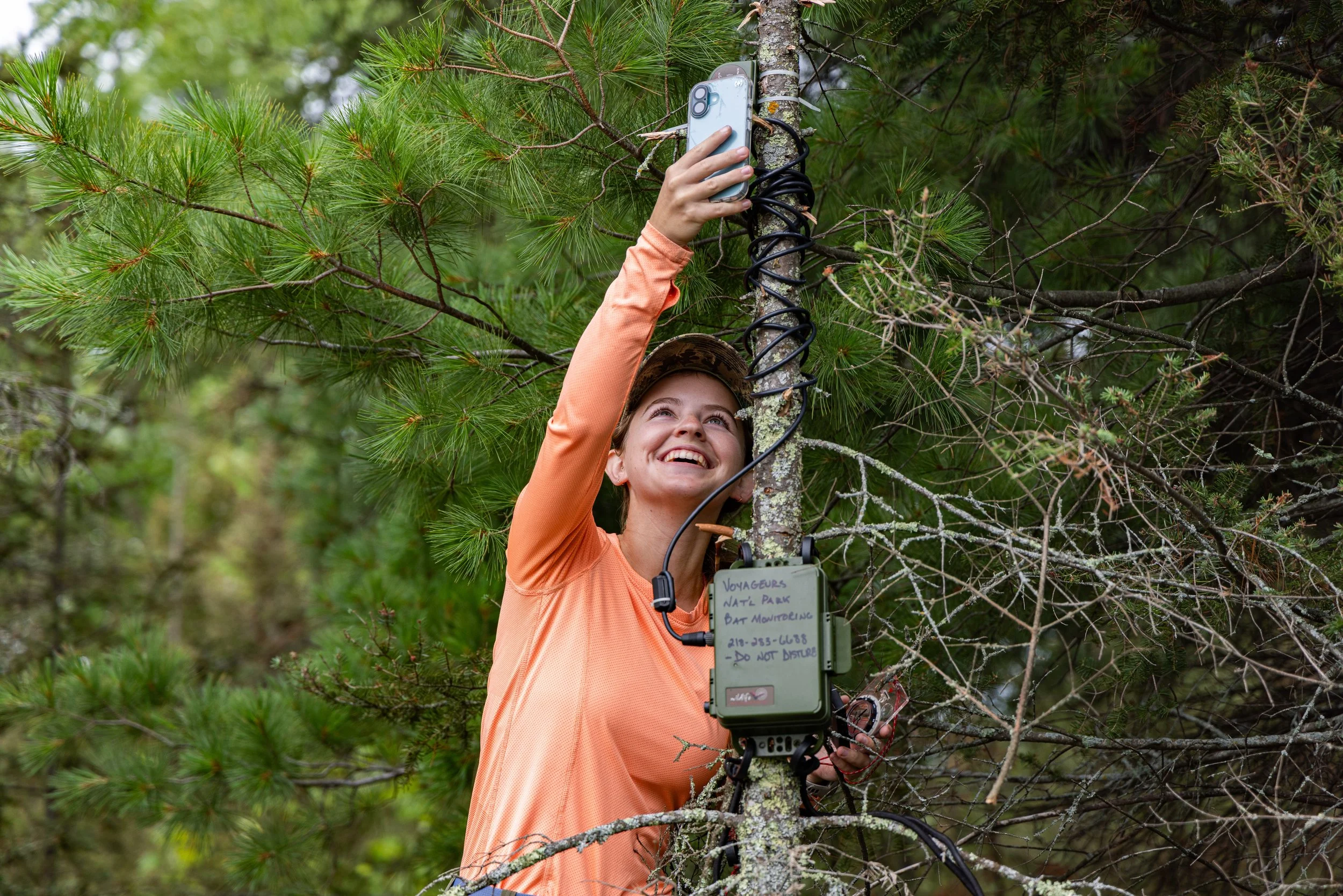
Podas orients the acoustic monitoring device and documents its surroundings at a remote site. In 2025, Voyageurs added nine monitoring locations outside its original sampling cells, helping researchers begin comparing bat activity in backcountry and more accessible areas of the park.
Some of those backcountry sites were where I joined Jacob and Mari. Reaching them meant leaving the motorboat behind, loading ourselves and our equipment into a canoe, paddling farther into the park, and eventually continuing on foot through the forest.
Putting in that effort expands what researchers can ask about bats across this enormous landscape: Are we hearing the same bat communities in the park's remote interior as we are in its more accessible areas? Are species of conservation concern using these backcountry habitats? And will those patterns remain the same five, ten, or twenty years from now?
Answering questions like these requires more than a single field season. It requires sustained investment in the people, equipment, partnerships, and long-term monitoring programs that make this kind of science possible.
Wildlife as an Early Signal
The importance of monitoring goes beyond knowing which bats live in Voyageurs. As Jacob explained, wildlife populations can tell us when something in an ecosystem is changing.
“Wildlife are really great at telling us when something is going on in the environment.”
A decline in bat activity at a site where a particular species has historically been common could prompt researchers to start asking why. Perhaps migration or roosting timing has shifted. Habitat conditions may have changed. Competition for resources could be different. Disease could be affecting populations.
One year of data may not answer those questions, but years of consistent monitoring can reveal patterns that would otherwise be almost impossible to recognize. That is especially important for bats, which face pressures ranging from habitat and climate changes to diseases such as white-nose syndrome, which has caused severe declines in several North American bat species.
Science Beyond Park Boundaries
What happens in Voyageurs also doesn't necessarily stay in Voyageurs. Some bats may remain within the broader region to hibernate, while migratory species can travel enormous distances between their summer and winter ranges.
For Jacob, that's one of the most rewarding parts of the project.
“The data we collect supports decision making far beyond our local ecosystem.”
A decline detected at Voyageurs could be connected to conditions hundreds or even thousands of miles away—a difficult migration, changes in habitat elsewhere, or problems at important winter hibernation sites. That makes bat conservation inherently collaborative. Data collected from a microphone mounted to a tree deep within Voyageurs can become one small piece of a much larger effort to understand bat populations across North America.
Listening to a Landscape After Dark
As a field biologist, I loved seeing how much information can come from simply recording what moves through the forest after we leave. We spent the day traveling across lakes, paddling into remote areas, hiking through the woods, taking measurements, recording notes, and carefully positioning microphones. Then we packed our equipment and left.
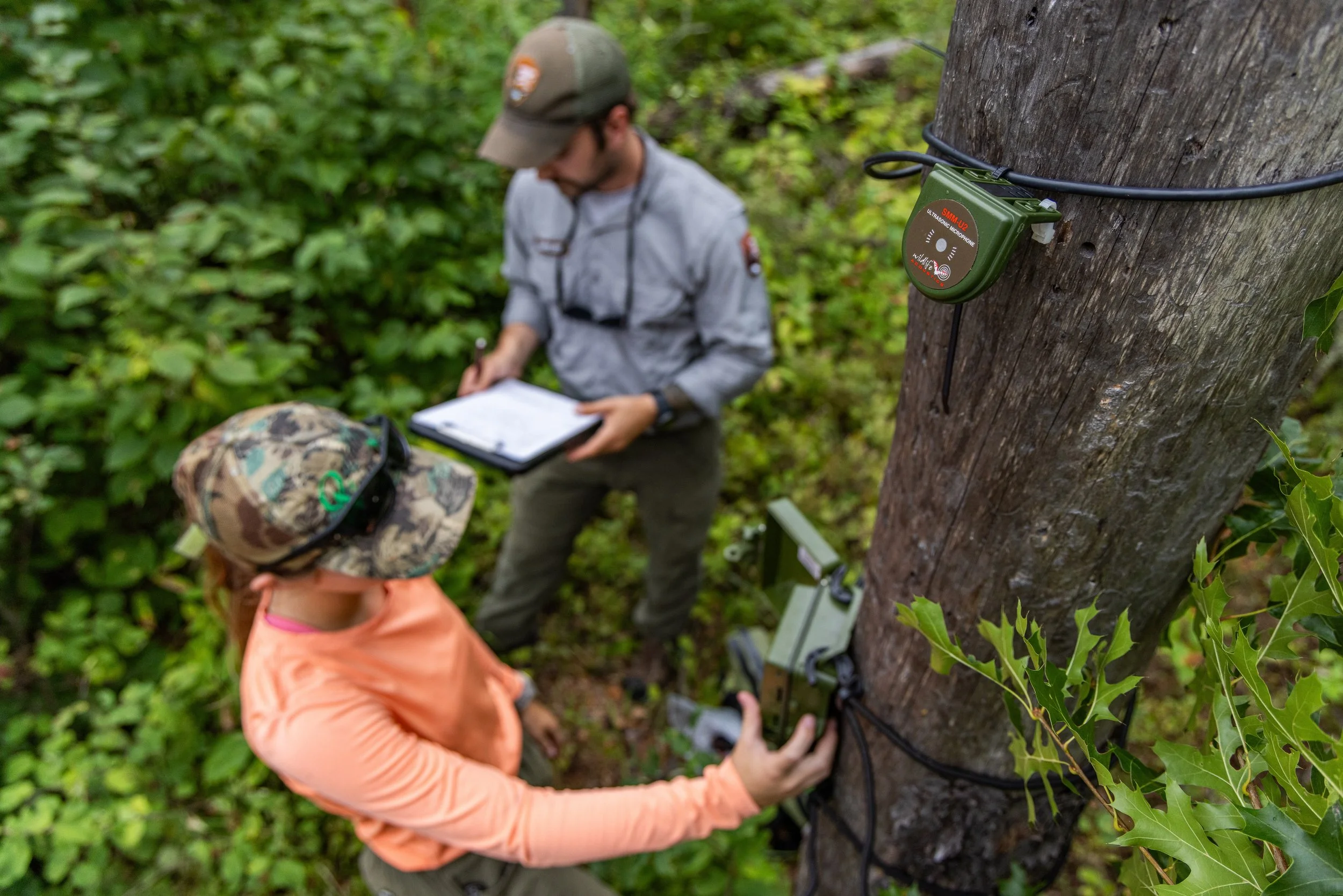
An ultrasonic microphone waits for nightfall while Schiefelbein and Podas finish work at a monitoring site. Long after the researchers leave, the equipment continues listening—recording bat calls that would otherwise pass unheard by human ears.
For the next week or two, those little monitors would remain behind, listening every night.
And while bats can be easy to overlook, their role in ecosystems is anything but small. They are important consumers of insects and part of the complex food webs that keep forest ecosystems functioning.
Jacob hopes visitors leave with a greater appreciation for that role.
“I wish visitors understood more deeply how important bats are…as moderators of insects, like mosquitoes.”
Long-term research like this doesn't happen in isolation. It depends on dedicated National Park Service staff, partners, Field Fellows, equipment, funding, and the ability to return to these places year after year. Support for Voyageurs Conservancy helps strengthen the science, stewardship, and conservation work that allows us to better understand the wildlife of Voyageurs National Park and the changes these animals may be telling us about.
Every recorded call adds another piece to a dataset stretching back more than a decade—helping scientists understand where bats occur, how active they are, and whether those patterns are changing.
Sometimes understanding wildlife means seeing what is there. Other times, it means listening.
